


Page 10 - BH-1-1
P. 10
Brain & Heart                                                      Application of the neural networks surgery


              In the 21   century, this field is commonly described
                      st
            as the developmental consequence of three dimensions
            (anatomy and cognitive discovery of the brain, medical
            imaging innovations, and medical devices). The history
            of neurosurgery can be divided into three stages: classical
            neurosurgery, microsurgery, and minimally invasive
            neurosurgery. Research on neural networks and advances
            in digital stereometric brain imaging today have led to the
                                                   [1]
            emergence of the field of neural networks surgery .
              In the last decades, with the development and
            application of advanced imaging equipment, multiple
            imaging techniques, including computed tomography
            (CT), magnetic resonance imaging (MRI), digital
            subtraction  angiography  (DSA),  single  photon  emission
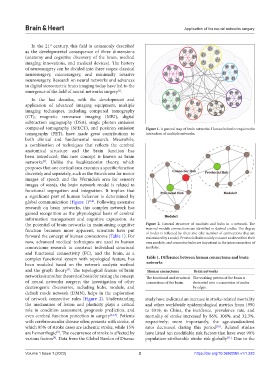
            computed tomography (SPECT), and positron emission   Figure 1. A general map of brain networks. Human behavior requires the
            tomography (PET), have made great contributions to   interaction of multiple networks.
            both clinical and fundamental research. Meanwhile,
            a combination of techniques that reflects  the cerebral
            anatomical structure and the brain function has
            been introduced; this new concept is known as brain
            networks . Unlike the localizationist theory, which
                   [2]
            proposes that one cortical area executes a specific function
            discretely and separately, such as the Broca’s area for motor
            images of speech and the Wernicke’s area for sensory
            images  of  words,  the  brain  network  model  is  related  to
            functional segregation and integration. It implies that
            a significant part of human behavior is determined by
            global communication (Figure 1) [3,4] . Following extensive
            research on brain networks, this complex network has
            gained recognition as the physiological basis of cerebral
            information  management  and  cognitive  expression.  As
            the potential of brain networks in maintaining cognitive   Figure  2. General structure of modules and hubs in a network. The
            function becomes  more apparent, scientists have  put   internal module connections are identified in dashed circles. The degree
                                                               of nodes is reflected by their size (the number of connections that are
            forward the concept of human connectome (Table 1). For   maintained by a node). Provincial hubs mainly connect nodes within their
            now, advanced medical techniques are used in human   own module, and connector hubs are important in the interconnection of
            connectome  research  to  construct  individual  structural   modules.
            and functional connectivity (FC), and the brain, as a
            complex functional system with topological feature, has   Table 1. Difference between human connectome and brain
            been  modeled  based  on  the  network  analysis  method   networks
            and the graph theory . The topological feature of brain   Human connectome  Brain networks
                             [5]
            networks is another theoretical basis for raising the concept   The functional and structural  The working pattern of the brain is
            of neural networks surgery; the investigation of other   connections of the brain.  abstracted into a connection of nodes
            deuterogenic discoveries, including hubs, module, and                  by edges.
            default mode network (DMN), helps in the exploration
            of network connective rules (Figure  2). Understanding   study have indicated an increase in stroke-related mortality
            the mechanism of lesion and plasticity plays a critical   and other worldwide epidemiological metrics from 1990
            role in condition assessment, prognosis prediction, and   to 2019; in China, the incidence, prevalence rate, and
            even cerebral function protection in surgery [3,6,7] . Patients   mortality of stroke increased by 86%, 106%, and 32.3%,
            with cerebrovascular disease often presents with stroke, of   respectively; more importantly, the age-standardized
            which 85% of stroke cases are ischemic stroke, while 15%   rates decreased during this period . Related studies
                                                                                             [10]
            are hemorrhagic . The occurrence of stroke is affected by   have listed ten modifiable risk factors that have over 90%
                         [8]
            various factors . Data from the Global Burden of Disease   population-attributable stroke risk globally . Due to the
                        [9]
                                                                                                  [11]
            Volume 1 Issue 1 (2023)                         2                       https://doi.org/10.36922/bh.v1i1.223

