


Page 15 - BH-1-1
P. 15
Brain & Heart                                                      Application of the neural networks surgery


            carotid endarterectomy (CEA) was not statistically   hubs and interregional connections are the key factors in
            significant, but a higher rate of new ischemic lesions   maintaining the stability of brain networks and ensuring
            was observed in  carotid artery stenting-treated  patients   their plasticity. Studies have described several critical
            compared with CEA-treated ones . Another research   indicators that can be applied in the prediction of cognitive
                                        [64]
            on neuropsychological sequelae prediction following   situation, prognosis, and even the cognitive  recovery of
            treatment with microsurgical clipping or endovascular   patients with the central nervous system diseases.
            embolization in patients with anterior communicating   The prediction of cognitive decline in multiple
            artery aneurysm has indicated that microsurgical clipping-  sclerosis (MS) patients is usually considered difficult. In
            treated patient had significantly more severe cognitive   their  clinical  study,  Nauta  et al.  investigated  the  role  of
            deficits . All the above studies are evidence showing   magnetoencephalography (MEG) in measuring functional
                 [12]
            that cognitive protection in cerebrovascular diseases has   brain network organization to predict cognitive decline
            received its due attention and further research and clinical   in MS patients; using resting-state MEG recordings,
            trials must follow their lead.                     structural MRI, and neuropsychological assessments,
              By reviewing neurological research and clinical trials,   they  found  that the level of functional  brain  network
            we put forward three new strategies for the surgical   integration is an independent predictive marker of
            treatment of cerebrovascular disease. As hubs and   cognitive decline and suggested that MEG may be a
                                                                                                           [65]
            connectivity are critical components of brain networks,   great prediction tool for disease progression in MS .
            they play an irreplaceable role in maintaining the stability   In a study of AD patients with MCI, Zhang et al. used a
            of the global network to preserve human cognitive function   proposed highly-available nodes approach to develop a
            (Table 2). As the preservation of human cognitive function   brain network model based on rest-state fMRI data; they
            has gained widespread attention clinically, the concept of   successfully constructed a reliable  brain network model
            neural networks surgery provides us an immense insight   and also identified 18 significant regions as hubs. This
            into the treatment of cerebrovascular disease. As discussed   model can be used to predict cognitive impairment in
            above, the protection of network hubs and connectivity   AD patients and analyze the topological feature of brain
            relates to better cognitive recovery and preserves the   networks . Moreover, in a study comprising Parkinson’s
                                                                      [66]
            human central nervous system up to a point of plasticity.   disease (PD) patients with MCI (PD-MCI), PD patients
            There is an urgent need for new strategies in neurosurgery   without  MCI  (PD-nMCI),  and  HC,  Chen  et al.  found
            to be developed and applied in clinical settings.  that all three groups exhibited small-world architecture in
                                                               their functional brain networks, and early-stage PD-MCI
            4. Impact on the course of the disease             patients had decreased clustering coefficient, increased
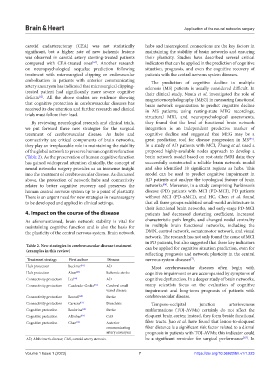
            As aforementioned, brain network stability is vital for   characteristic path length, and changed nodal centrality
            maintaining cognitive function and is also the basis for   in multiple brain functional networks, including the
            the plasticity of the central nervous system. Brain network   DMN, control network, somatomotor network, and visual
                                                               network. The research has not only found the cause of MCI
                                                               in PD patients, but also suggested that these key indicators
            Table 2. New strategies in cerebrovascular disease treatment
            (examples in this review)                          can be applied for cognitive situation prediction, even for
                                                               reflecting prognosis and network plasticity in the central
             Treatment strategy  First author  Disease         nervous system diseases .
                                                                                  [7]
            Hub protection    Buckner [52]    AD                 Most cerebrovascular diseases often begin with
            Hub protection    Aben [43]       Ischemic stroke  cognitive impairment or are accompanied by symptoms of
            Connectivity protection  Lee [58]  AD              cognitive dysfunction. In a deeper study of brain networks,
            Connectivity protection  Cuadrado-Godia [59]  Cerebral small    many scientists focus on the evaluation of cognitive
                                              vessel disease   impairment and long-term prognosis of patients with
            Connectivity protection  Bosnell [60]  Stroke      cerebrovascular disease.
            Connectivity protection  Carrera [61]  Diaschisis    Temporo-occipital    junction    arteriovenous
            Cognitive protection  Boukrina [62]  Stroke        malformations (TOJ-AVMs) certainly do not affect the
            Cognitive protection  Altinbas [64]  CAS           eloquent brain cortex; instead, they form beside functional
            Cognitive protection  Chan [12]   Anterior         fiber tracts. Jiao et al. have found that lesion-to-eloquent
                                              communicating    fiber distance is a significant risk factor related to a dismal
                                              artery aneurysm  prognosis in patients with TOJ-AVMs; this indicator could
                                                                                                        [67]
            AD, Alzheimer’s disease; CAS, carotid artery stenosis.  be a  significant reminder for surgical performance . In

            Volume 1 Issue 1 (2023)                         7                       https://doi.org/10.36922/bh.v1i1.223

