


Page 101 - BH-2-2
P. 101
Brain & Heart                                                    Surviving rhino-orbital-cerebral mucormycosis


                         A                       B                       C


                         D                       E                       F


                                      G                     H


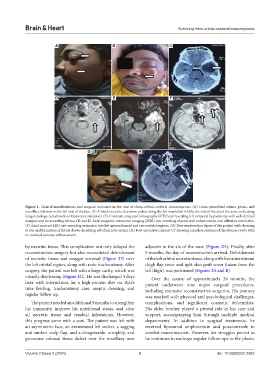
            Figure 1. Clinical manifestations and surgical outcomes in the case of rhino-orbital-cerebral mucormycosis. (A) Gross periorbital edema, ptosis, and
            maxillary fullness on the left side of the face. (B) A black necrotic ulcerative eschar along the left nasolabial fold by the side of the ala of the nose, indicating
            fungal etiology (a hallmark of Mucorales infection). (C) Contrast computed tomography (CT) head revealing left temporal hypodensity with well-defined
            margins and surrounding edema. (D and E) Axial magnetic resonance imaging (MRI) cuts revealing abscess wall enhancement and diffusion restriction.
            (F) Axial contrast MRI cuts revealing extension into left spenoethmoid and retroorbital regions. (G) Post-exenteration figure of the patient with dressing
            in situ and formation of fistula due to shredding off of necrotic eschar. (H) Post-operative contrast CT showing complete excision of the abscess cavity with
            no residual contrast enhancement.

            by necrotic tissue. This complication not only delayed the   adjacent to the ala of the nose (Figure 2H). Finally, after
            reconstruction surgery but also necessitated debridement   9 months, the day of reconstruction arrived. Debridement
            of necrotic tissue and maggot removal (Figure  2F) over   of the left orbital necrotic tissue, along with free anterolateral
            the left orbital region, along with redo tracheostomy. After   thigh flap cover and split skin graft cover (taken from the
            surgery, the patient was left with a large cavity, which was   left thigh), was performed (Figures 3A and B).
            visually displeasing (Figure 2G). He was discharged 4 days   Over  the  course of approximately 26  months, the
            later  with  instructions for  a  high-protein  diet  via  Ryle’s   patient  underwent  nine  major  surgical  procedures,
            tube feeding, tracheostomy care, aseptic dressing, and   including extensive reconstructive surgeries. His journey
            regular follow-up.                                 was marked with physical and psychological challenges,

              The patient needed an additional 9 months to strengthen   complications, and significant cosmetic deformities.
            his  immunity,  improve  his  nutritional  status,  and  clear   His older brother played a pivotal role in his care and
            all necrotic tissue and residual infestations. However,   support, accompanying him through multiple medical
            this progress came with a cost. The patient was left with   departments. In addition to surgical treatments, he
            an asymmetric face, an exenterated left socket, a sagging   received liposomal amphotericin and posaconazole to
            and sunken scalp flap, and a disagreeable, unsightly, and   combat mucormycosis. However, his struggles persist as
            gruesome  colossal  tissue  defect  over  the  maxillary  area   he continues to undergo regular follow-ups in the plastic


            Volume 2 Issue 2 (2024)                         3                                doi: 10.36922/bh.2083

