


Page 43 - BH-2-2
P. 43
Brain & Heart                                                    VR for TBI memory and eye fixation recovery


                                                               connect to the USB port of the laptop. The HTC Vive Pro
                                                               Eye headset contained built-in headphones as well as an
                                                               adjustable head strap and knob to tighten the headset. The
                                                               headset also included a head strap.
                                                                 Once the equipment was connected, the participants
                                                               were sitting in a chair with the controller in their dominant
                                                               hand, and the headset was adjusted to fit over their heads
                                                               like a ski mask by the VR technician. The headset gently
                                                               sat on their forehead, nose, and the strap on the upper
                                                               back of their head. The headset covered their eyes, and
                                                               the headphones attached to the headset covered their ears.
                                                               The technician then began to load the software SteamVR
                                                               to make sure the base, headset, and controller which
                                                               were turned on and connected. Once the equipment was
                                                               connected, the technician started the screen recording for
                                                               data collection and then began each scenario.
                                                               2.7. Data collection
                                                               Data collection included screen recordings of each
                                                               session and note taking by the VR technician on
                                                               qualitative observations. Participants completed an
                                                               objective prospective memory test before starting and
                                                               6  weeks later after VR participation. Participants were
                                                               asked to inform the researcher if they were left or right-
                                                               handed after 5 min had passed. Successful completion of
                                                               the test was determined by whether they remembered
                                                               what to tell the researcher within the specified timeframe.
                                                               In addition, participants completed a subjective
                                                               memory test, Prospective and Retrospective Memory
                                                               Questionnaire (PRMQ). 26,27  This is a self-report severity
                                                               measure  of  prospective  and  retrospective  memory
                                                               challenges in everyday life. Participants responded to this
                                                               Likert scale with response options ranging from 1 – 5,
                                                               with 1 indicating “never” and 5 indicating “very often.”
                                                               Item scores were summed to obtain a total final score,

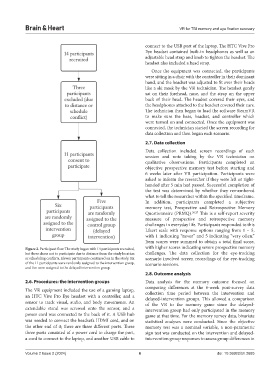
            Figure 2. Participant flow. The study began with 14 participants recruited,   with higher scores indicating severe prospective memory
            but three chose not to participate due to distance from the study location   challenges.  The data collection for  the eye-tracking
            or scheduling conflicts. Eleven participants continued on in the study. Six   scenario involved screen recordings of the eye-tracking
            of the 11 participants were randomly assigned to the intervention group,   scenario sessions.
            and five were assigned to the delayed intervention group.
                                                               2.8. Outcome analysis
            2.6. Procedures: the intervention groups           Data analysis for the memory outcome focused on
                                                               comparing differences at the 6-week post-survey data
            The VR equipment included the use of a gaming laptop,   collection time period between the intervention and
            an HTC Vive Pro Eye headset with a controller, and a   delayed-intervention  groups.  This  allowed  a  comparison
            sensor to track visual, audio, and body movements. An   of the VR to the memory game since the delayed-
            extendable stand was screwed onto the sensor, and a   intervention group had only participated in the memory
            power cord was connected to the back of it. A USB hub   game at that time. For the memory survey data, bivariate
            was needed to connect the headset’s HDMI cord, and on   statistical analyses were conducted. Since the objective
            the other end of it; there are three different ports. These   memory test was a nominal variable, a non-parametric
            three ports consisted of a power cord to charge the port,   sign test was conducted on the intervention and delayed-
            a cord to connect to the laptop, and another USB cable to   intervention group responses to assess group differences in


            Volume 2 Issue 2 (2024)                         6                                doi: 10.36922/bh.2685

