


Page 42 - BH-2-2
P. 42
Brain & Heart                                                    VR for TBI memory and eye fixation recovery


            not recently experienced a TBI, given the novelty of the   objective of the game to the participant, emphasizing the
            intervention and potential unknown side effects such as   use of prospective memory to obtain the most matching
            nausea. Exclusion criteria included: (i) Inability to provide   pairs. They provided a brief overview of the gameplay,
            consent for the study, (ii) severe vision impairment,   which involved flipping two tiles at once to determine if
            (iii) inability to hold and move a VR controller with one   they matched. If the tiles did not match, the other person
            hand, and (iv) neck or facial injury preventing the use of   took a turn, whereas if a match was found, the person
            a VR headset.                                      would continue taking additional turns until encountering
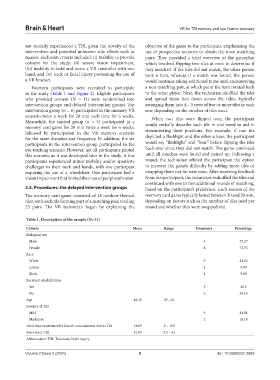
              Fourteen  participants  were  recruited  to  participate   a non-matching pair, at which point the turn rotated back
            in the study (Table 1  and  Figure  2). Eligible participants   to the other player. Next, the technician shuffled the tiles
            who provided consent (N = 11) were randomized into   and  spread them face  down across the  table,  typically
            intervention groups and delayed intervention groups. The   arranging them into 4 – 5 rows of five or more tiles in each
            intervention group (n = 6) participated in the memory VR   row, depending on the number of tiles used.
            scenario twice a week for 20 min each time for 6 weeks.   When two tiles were flipped over, the participant
            Meanwhile, the control group (n = 5) participated in a   would verbally describe each tile in one word to aid in
            memory card game for 20 min twice a week for 6 weeks,
            followed by participation in the VR memory scenario   remembering their positions. For example, if one tile
            for the same duration and frequency. In addition, the six   depicted a flashlight and the other a bear, the participant
            participants in the intervention group participated in the   would say “flashlight” and “bear” before flipping the tiles
            eye-tracking scenario. However, not all participants piloted   back over since they did not match. The game continued
            this scenario, as it was developed later in the study. A few   until all matches were found and paired up. Following a
            participants experienced minor mobility and/or spasticity   round, the technician offered the participant the option
            challenges  in  their neck  and hands, with  one participant   to increase the game’s difficulty by adding more tiles or
            requiring the use of a wheelchair. One participant had a   swapping them out for new ones. After receiving feedback
            vision impairment that limited their use of peripheral vision.  from the participant, the technician reshuffled the tiles and
                                                               continued with one to two additional rounds of matching,
            2.5. Procedures: the delayed intervention groups   based on the participant’s preference. Each session of the
            The memory card game consisted of 48 outdoor-themed   memory card game typically lasted between 20 and 30 min,
            tiles, with each tile forming part of a matching pair, totaling   depending on factors such as the number of tiles used per
            23 pairs. The VR technician began by explaining the   round and whether tiles were swapped out.


            Table 1. Description of the sample (N=11)
            Criteria                                      Mean         Range        Frequency        Percentage
            Biological sex
             Male                                                                       3              27.27
             Female                                                                     8              72.73
            Race
             White                                                                      9              81.82
             Latino                                                                     1              9.09
             Black                                                                      1              9.09
            Received rehabilitation
             Yes                                                                        5              45.5
             No                                                                         6              54.55
            Age                                           46.18        29 – 61
            Severity of TBI
             Mild                                                                       9              81.81
             Moderate                                                                   2              18.18
            Total days experienced a loss of consciousness due to TBI  19.09  0 – 150
            Years since TBI                               21.05        2.5 – 61
            Abbreviation: TBI: Traumatic brain injury.


            Volume 2 Issue 2 (2024)                         5                                doi: 10.36922/bh.2685

