


Page 41 - BH-2-2
P. 41
Brain & Heart                                                    VR for TBI memory and eye fixation recovery


            of times I’ve been in (brain injury support) group, and I   a chair. In a first-person perspective, they strolled down a
            hear someone say “I knew I shouldn’t say something, but   beach near the shore, where waves crashed, and seagulls
            I couldn’t stop myself.” One person reported that memory   flew sporadically yet slowly in front of them. There was
            was a challenge and even thought of an idea for a scenario:   a ball positioned at the horizon that they were prompted
            “Almost like making a map in our mind. Along the path,   to focus on, under the guidance of a VR technician. The
            there’s an apple tree, and under the apple tree, there’s an   ball turned green when they were looking at it and turned
            object that you need to remember. And then along the way,   red when they were not. The HTC Vive Pro Eye headset
            there are these objects associated with something along the   enables pupil tracking, which is what turns the ball green
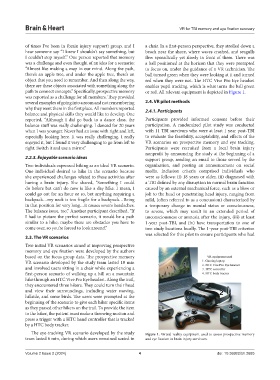
            path to connect concepts.” Specifically, prospective memory   or red. All relevant equipment is depicted in Figure 1.
            was reported as a challenge for all members. They provided
            several examples of going into a room and not remembering   2.4. VR pilot methods
            why they went there in the first place. All members reported   2.4.1. Participants
            balance and physical skills they would like to develop. One
            reported, “Although I did go back to a dance class, the   Participants provided informed consent before their
            balance stuff was really challenging. I danced for 20 years   participation.  A  randomized pilot study  was conducted
            when I was younger. Never had an issue with right and left,   with 11 TBI survivors who were at least 1 year post-TBI
            especially looking here. It was really challenging. I really   to evaluate the feasibility, acceptability, and effects of the
            enjoyed it, but I found it very challenging to go from left to   VR scenarios on prospective memory and eye tracking.
            right. Switch it and use a mirror.”                Participants were recruited from a local brain injury
                                                               nonprofit by announcing the study at the beginning of a
            2.2.3. Enjoyable scenario ideas                    support group, sending an email to those served by the
            Two individuals expressed hiking as an ideal VR scenario.   organization, and posting an announcement on social
            One individual desired to hike in the scenario because   media. Inclusion criteria comprised individuals who
            she experienced challenges related to these activities after   were as follows: (i) 18 years or older, (ii) diagnosed with
            having a brain injury. She shared, “Something I could   a TBI defined by any disruption in normal brain function
            do before but can’t do now is like a day hike. I mean, I   caused by an external mechanical force, such as a blow or
            could go out for an hour or so, but anything requiring a   jolt to the head or penetrating head injury, ranging from
            backpack…my neck is too fragile for a backpack…Being   mild, (often referred to as a concussion) characterized by
            in that position for very long…it causes severe headaches.   a temporary change in mental status or consciousness,
            The balance issue, too.” Another participant described, “If   to severe, which may result in an extended period of
            I had to picture the perfect scenario, it would be a path   unconsciousness or amnesia after the injury, (iii) at least
            similar to a hike; maybe there are obstacles you have to   1-year post-TBI, and (iv) have transportation to one of
            come over, so you’re forced to look around.”       two study locations locally. The 1-year post-TBI criterion
                                                               was selected for this pilot to ensure participants who had
            2.3. The VR scenarios
            Two initial VR scenarios aimed at improving prospective
            memory and eye fixation were developed by the authors
            based on the focus group data. The prospective memory
            VR scenario developed by the study team lasted 10 min
            and involved users sitting in a chair while experiencing a
            first-person scenario of walking up a hill on a mountain
            hike through an HTC Vive Pro Eye headset. Along the trail,
            they encountered three hikers. They could turn their head
            and view their surroundings, including water moving,
            hillside, and some birds. The users were prompted at the
            beginning of the scenario to give each hiker specific items
            as they passed other hikers on the trail. To provide the item
            to the hiker, the patient must make a throwing motion and
            press a trigger with a HTC hand controller that is tracked
            by a HTC body tracker.
              The eye-tracking VR scenario developed by the study   Figure 1. Virtual reality equipment used to assess prospective memory
            team lasted 6 min, during which users remained seated in   and eye fixation in brain injury survivors.


            Volume 2 Issue 2 (2024)                         4                                doi: 10.36922/bh.2685

