


Page 45 - BH-2-2
P. 45
Brain & Heart                                                    VR for TBI memory and eye fixation recovery


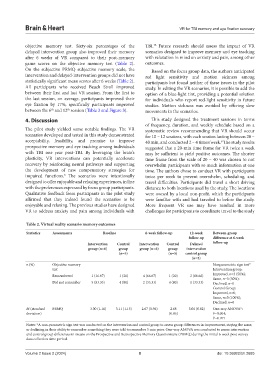
            objective memory test. Sixty-six percentages of the   TBI.  Future research should assess the impact of VR
                                                                  28
            delayed intervention group also improved their memory   scenarios designed to improve memory and eye tracking
            after 6  weeks of VR compared to their post-memory   with relaxation in mind on anxiety and pain, among other
            game scores on the objective memory test (Table 2).   outcomes.
            On the subjective PRMQ subjective memory scale, the   Based on the focus group data, the authors anticipated
            intervention and delayed-intervention groups did not have   red light sensitivity and motion sickness among
            statistically significant mean scores after 6 weeks (Table 2).   participants but found neither of these issues in the pilot
            All  participants who received Beach  Stroll  improved   study. In editing the VR scenarios, it is possible to add the
            between their first and last VR session. From the first to   option of a blue-light tint, providing a potential solution
            the  last  session,  on  average,  participants  improved  their   for individuals who report red-light sensitivity in future
            eye fixation by 17%; specifically participants improved   studies. Motion sickness was avoided by offering slow
            between the 6  and 12  session (Table 3 and Figure 3).  movements in the scenarios.
                       th
                              th
            4. Discussion                                        This study designed the treatment sessions in terms
                                                               of frequency, duration, and weekly schedule based on a
            The  pilot  study yielded  some  notable  findings.  The VR   systematic review recommending that VR should occur
            scenarios developed and tested in this study demonstrated   for 10 – 12 sessions, with each session lasting between 20 –
            acceptability, feasibility, and promise to improve   40 min, and conducted 2 – 4 times/week.  The study results
                                                                                               8
            prospective memory and eye tracking among individuals   suggested that a 20-min time frame for VR twice a week
            with TBI one year post-TBI. By leveraging the brain’s   may be sufficient to yield positive outcomes. The shorter
            plasticity,  VR  interventions  can  potentially  accelerate   time frame from the scale of 20 – 40 was chosen to not
            recovery by reinforcing neural pathways and supporting   overwhelm participants with so much information at one
            the development of new compensatory strategies for   time. The authors chose to conduct VR with participants
            impaired  functions.   The  scenarios  were  intentionally   twice per week to prevent overwhelm, scheduling, and
                            8
            designed to offer enjoyable and relaxing experiences, in line   travel difficulties. Participants did travel a short driving
            with the preferences expressed by focus group participants.   distance to both locations used by the study. The locations
            Qualitative feedback from participants in the pilot study   were owned by a local non-profit, which the participants
            affirmed that they indeed found the scenarios to be   were familiar with and had traveled to before the study.
            enjoyable and relaxing. The previous studies have designed   More  frequent  VR  use  may  have  resulted  in  more
            VR to address anxiety and pain among individuals with   challenges for participants to coordinate travel to the study


            Table 2. Virtual reality scenario memory outcomes
            Statistics  Assessments          Baseline          6‑week follow‑up   12‑week   Between‑group
                                                                                 follow‑up  difference at 6‑week
                                      Intervention   Control   Intervention   Control   Delayed   follow‑up
                                       group (n=6)  group   group (n=6)  group   intervention
                                                    (n=5)                (n=5)  control group
                                                                                   (n=3)
            n (%)      Objective memory                                                     Nonparametric sign test*
                       test                                                                 Intervention group:
                       Remembered       1 (16.67)   1 (20)    4 (66.67)  1 (20)   2 (66.66)  Improved, n=3 (50%);
                                                                                            Same, n=3 (50%);
                       Did not remember  5 (83.33)  4 (80)    2 (33.33)  4 (80)   1 (33.33)  Declined, n=0
                                                                                            Control Group:
                                                                                            Improved, n=0;
                                                                                            Same, n=5 (100%);
                                                                                            Declined, n=0
            M (standard   PRMQ         3.00 (1.16)  3.11 (1.15)  2.67 (0.96)  2.68   3.06 (0.82)  One-way ANOVA*:
            deviation)                                                   (0.86)             F=0.001;
                                                                                            P=0.971
            Notes: *A non-parametric sign test was conducted on the intervention and control group to assess group differences in improvement, staying the same,
            or declining in their ability to remember something they were told to remember 5 min prior. One-way ANOVA was conducted to assess intervention
            and control group differences in means on the Prospective and Retrospective Memory Questionnaire (PRMQ) during the initial 6-week post-survey
            data collection time period.


            Volume 2 Issue 2 (2024)                         8                                doi: 10.36922/bh.2685

