


Page 50 - BH-2-2
P. 50
Brain & Heart                                              Cerebral venous sinus assessment using MRI and CT


            1. Introduction                                    2.2. Image acquisitions

            Pulsatile tinnitus (PT) is often related to an underlying   The MRI data were acquired using a 3.0T MRI unit
            vascular abnormality, significantly affecting the patient’s   (Ingenia, Philips Healthcare, Netherlands) equipped with
            quality of life.  Cerebral venous stenosis-induced PT   a 16-channel head coil. The MRI examinations employed
                        1
            has gained increasing recognition, with venous sinus   a 3D phase-contrast technique using a gradient-echo
            stenting (VSS) emerging as an effective treatment option   sequence with the following parameters: field of view of
                                                                                3
            for symptom relief.  Transverse sinus stenosis (TSS) is   173 × 173 × 192 mm , repetition time of 17 ms, echo time
                            2
            a commonly observed vascular abnormality in patients   of 6.2 ms, flip angle of 10°, velocity encoding of 15 cm/s,
            with PT.  The previous studies have highlighted the high   bandwidth of 230 Hz/pixel, matrix size of 144 × 108 × 120,
                   3
            diagnostic performance of both computed tomography   and acquisition time of 2 min 15 s.
            venography (CTV) and magnetic resonance venography   CTV images were acquired using a 256-section
            for anatomical analysis of venous sinuses.  The choice   CT scanner (Revolution, GE Healthcare, US) with the
                                                4
            of modality generally depends on availability, although   following parameters: tube voltage of 100 kV, 25mAs (auto-
            comparisons between modalities have been rarely assessed.
                                                               mAs), matrix of 512 × 512, collimation of 256×0.625 mm,
              Anatomical assessment is widely conducted using   rotation time of 0.5 s, pitch of 0.992:1, and administration
            CTV and Phase-contrast magnetic resonance imaging   of contrast media (iopamidol, Bracco Diagnostics, UK) at
            (MRI).  Computed tomography (CT) remains the primary   a concentration of 370 mg iodine/ml, 1.5 ml/kg, injected
                 5,6
            approach for differentiating the source of vascular-related   at a  rate of  5  ml/s.  The average  CT dose  index (CTDI)
            tinnitus, due to its high spatial resolution and consequent   was 63.95 mGy, and the average total dose length product
            high  diagnostic  accuracy.   On  the  other  hand,  MRI   (DLP) was 664.3 mGy∙cm.
                                  3
            has increasingly been applied for intracranial venous
            assessment, offering advantages such as superior soft-tissue   2.3. Reconstruction of 3D geometry models
            contrast without interference bone structures, as shown in   The anatomies of the cases were reconstructed using
            CT images.  Therefore, MRI is considered a promising tool   Mimics 19.0 (Materialise, Belgium). The region of interest
                     7-9
            for analyzing the vasculature and the defects of surrounding   was segmented based on the signal intensity distribution
            tissues, including vascular interface, meningeal defects, and   of MRI and CTV images. Consultation with clinical
            related malformations.  However, the previous studies   technicians was conducted to improve the accuracy of
                              7,9
            have reported potential false-positive diagnoses due to slow   3D geometric reconstruction. The major segments of the
            blood flow and artifacts in MRI, leading to ongoing debates   intracranial venous network were evaluated, including the
            regarding abnormalities in unilateral transverse dural   TSs, sigmoid sinuses (SSs), straight sinuses (StSs), inferior
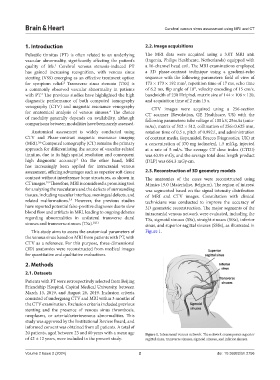
            sinuses and transverse sinuses (TSs). 10,11        sinus, and superior sagittal sinuses (SSSs), as illustrated in

              This study aims to assess the anatomical parameters of   Figure 1.
            the venous sinus based on MRI from patients with PT, with
            CTV as a reference. For this purpose, three-dimensional
            (3D) anatomies were reconstructed from medical images
            for quantitative and qualitative evaluations.
            2. Methods

            2.1. Datasets
            Patients with PT were retrospectively selected from Beijing
            Friendship Hospital, Capital Medical University, between
            March 13, 2019, and August 26, 2019. Inclusion criteria
            consisted of undergoing CTV and MRI within 3 months of
            the CTV examination. Exclusion criteria included previous
            stenting  and  the  presence  of  venous  sinus  thrombosis,
            neoplasms, or arterial/arteriovenous abnormalities. This
            study was approved by the Institutional Review Board, and
            informed consent was obtained from all patients. A total of
            20 patients, aged between 23 and 60 years with a mean age   Figure 1. Intracranial venous network. The network encompasses superior
            of 42 ± 12 years, were included in the present study.  sagittal sinus, transverse sinuses, sigmoid sinuses, and inferior sinuses.


            Volume 2 Issue 2 (2024)                         2                                doi: 10.36922/bh.2756

