


Page 51 - BH-2-2
P. 51
Brain & Heart                                              Cerebral venous sinus assessment using MRI and CT


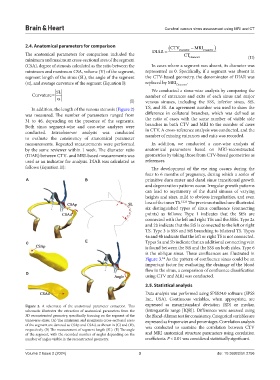
            2.4. Anatomical parameters for comparison                    (CTV     − MRI     )

            The anatomical parameters for comparison included the   DIAR  =  Diameter  Diameter
                                                                               CT
            minimum and maximum cross-sectional area of the segment               Diameter                 (II)
            (CSA), degree of stenosis calculated as the ratio between the   In cases where a segment was absent, its diameter was
            minimum and maximum CSA, volume (V) of the segment,   represented as 0. Specifically, if a segment was absent in
            segment length of the sinus (SL), the angle of the segment   the CTV-based geometry, the denominator of DIAR was
            (α), and average curvature of the segment (Equation I):  replaced by MRI Diameter .

                         SL                                      We conducted a sinus-wise analysis by comparing the
                       =
               Curvature                                       number of entrances and exits of each sinus and major
                         α                              (I)    venous  sinuses,  including  the  SSS,  inferior  sinus,  StS,
              In addition, the length of the venous stenosis (Figure 2)   TS, and SS. An agreement number was used to show the
            was  measured.  The  number  of  parameters  ranged  from   difference in collateral branches, which was defined as
            31 to 46, depending on the presence of  the segments.   the ratio of cases with the same number of visible side
            Both sinus segment-wise and case-wise analyses were   branches in both CTV and MRI to the number of cases
            conducted. Intraobserver analysis was conducted    in CTV. A cross-reference analysis was conducted, and the
            to evaluate the consistency of anatomical parameter   number of missing entrances and exits was recorded.
            measurements. Repeated measurements were performed   In addition, we conducted a case-wise analysis of
            by the same reviewer within 1 week. The diameter ratio   anatomical parameters based on MRI-reconstructed
            (DIAR) between CTV- and MRI-based measurements was   geometries by taking those from CTV-based geometries as
            used as an indicator for analysis. DIAR was calculated as   references.
            follows (Equation II):                               The development of the eye ring occurs during the
                                                               four to 6 months of pregnancy, during which a series of
            A                        B                         primitive dura mater and dural sinus transitional growth
                                                               and degeneration patterns occur. Irregular growth patterns
                                                               can lead to asymmetry of the dural sinuses of varying
                                                               heights and sizes, mild to obvious irregularities, and even
                                                               loss of the inner TS. 12,13  The previous studies have illustrated
                                                               six distinguished types of sinus confluence (connecting
                                                               points) as follows: Type  1 indicates that the StSs are
                                                               connected with the left and right TSs and the SSSs. Type 2a
                                                               and 2b indicate that the StS is connected to the left or right
                                                               TS. Type 3 is SSS and StS branching to bilateral TS. Types
                                                               4a and 4b indicate that the left or right TS is not connected.
            C                        E                         Types 5a and 5b indicate that an additional connecting vein
                                                               is found between the StS and the SSS on both sides. Type 6
                                                               is the oblique sinus. These confluences are illustrated in
                                                               Figure 3.  As the pattern of confluence sinus could be an
                                                                      14
                                                               important factor for evaluating the drainage of the blood
                                                               flow in the sinus, a comparison of confluence classification
            D
                                                               using CTV and MRI was conducted.
                                                               2.5. Statistical analysis
                                                               Data analysis was performed using SPSS24.0 software (SPSS
                                                               Inc., USA). Continuous variables, when appropriate, are
            Figure  2.  A  schematic of the anatomical parameter extraction. This   expressed as mean±standard deviation (SD) or median
            schematic illustrates the extraction of anatomical parameters from the   (interquartile range [IQR]). Differences were assessed using
            3D reconstructed geometry, specifically focusing on the segment of the   the Bland-Altman test for consistency. Categorical variables are
            transverse sinus. (A) The minimum and maximum cross-sectional areas   expressed as frequencies and percentages. Correlation analysis
            of the segment are denoted as CSAp and CSAd, as shown in (C) and (D),   was conducted to examine the correlation between CTV
            respectively. (B) The measurement of segment length (SL). (E) The angle
            of the segment, with the recorded number of angles depending on the   and MRI anatomical structure parameters using correlation
            number of angles visible in the reconstructed geometry.  coefficients. P < 0.01 was considered statistically significant.


            Volume 2 Issue 2 (2024)                         3                                doi: 10.36922/bh.2756

