


Page 56 - BH-2-2
P. 56
Brain & Heart                                              Cerebral venous sinus assessment using MRI and CT


            Table 1. Results of the repeated measurement for intraobserver analysis using diameter ratio as an indicator
            Segments      ConS      Rstn       Sts      SSS       RTS       RSS       LTS       Lstn      LSS
            Correlations   0.977    0.993     0.9805    0.988    0.9772     0.9923    0.9605    0.996    0.995
            Abbreviations: ConS: Confluent sinus; LSS: Left sigmoid sinus; Lstn: Left stenosis; LTS: Left transverse sinus; RSS: Right sigmoid sinus; Rstn: Right
            stenosis; RTS: Right transverse sinus; SSS: Superior sagittal sinus; Sts: Straight sinus.

            based analysis (20% and 35%, respectively). The number
            of cases for Type 4a and Type 6 was consistent between
            CTV and MRI (Two cases each for Type  4a and 1  case
            for Type  6). Variations in confluence were observed in
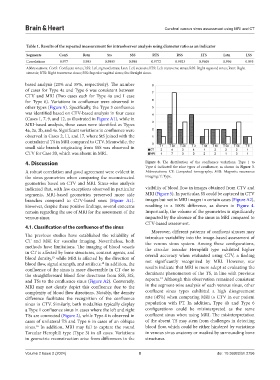
            other types (Figure 9). Specifically, the Type 3 confluence
            was identified based on CTV-based analysis in four cases
            (Cases 1, 7, 9, and 12, as illustrated in Figure A1), while in
            MRI-based analysis, these cases were identified as Types
            4a, 2a, 2b, and 4a. Significant variations in confluence were
            observed in Cases 2, 11, and 17, where StS joined with the
            contralateral TS in MRI compared to CTV. Meanwhile, the
            small side branch originating from SSS was observed in
            CTV for Case 20, which was absent in MRI.
            4. Discussion                                      Figure  8. The distribution of the confluence variations. Type  1 to
                                                               Type  6 indicated the nine types of confluence, as shown in  Figure  3.
            A robust correlation and good agreement were evident in   Abbreviations: CT: Computed tomography; MRI: Magnetic resonance
            the sinus geometries when comparing the reconstructed   imaging; T: Type.
            geometries based on CTV and MRI. Sinus-wise analysis
            indicated that, with few exceptions observed in particular   visibility of blood flow in images obtained from CTV and
            segments, MRI-based geometries preserved more side   MRI (Figure 5). In particular, SS could be captured in CTV
            branches compared to CTV-based ones (Figure A1).   images but not in MRI images in certain cases (Figure A2),
            However, despite these positive findings, several concerns   resulting  in  a  100%  difference,  as  shown  in  Figure  4.
            remain regarding the use of MRI for the assessment of the   Importantly, the volume of the geometries is significantly
            venous sinus.                                      impacted by the absence of the sinus in MRI compared to
                                                               CTV-based assessment.
            4.1. Classification of the confluence of the sinus
                                                                 Moreover, different patterns of confluent sinuses may
            The previous studies have established the reliability of   introduce variability into the image-based assessment of
            CT and MRI for vascular imaging. Nevertheless, both   the  venous  sinus  system. Among these  configurations,
            methods have limitations. The imaging of blood vessels   the circular torcular Herophili type exhibited higher
            in CT is affected by bone structures, contrast agents, and   overall  accuracy  when  evaluated  using  CTV,  a  finding
            blood density,  while MRI is affected by the direction of
                       15
            blood flow, signal strength, and artifacts.  In addition, the   not significantly recognized by MRI. However, our
                                            10
            confluence of the sinus is more discernible in CT due to   results indicate that MRI is more adept at evaluating the
            the straightforward blood flow directions from SSS, StS,   dominant phenomenon of the TS, in line with previous
                                                                     13
            and TSs to the confluence sinus (Figure A2). Conversely,   reports.  Although this observation remained consistent
            MRI may  not  clearly depict this confluence  due to the   in the segment-wise analysis of each venous sinus, other
            complexity of blood flow directions. Notably, the density   confluent sinus types exhibited a high disagreement
            difference facilitates the recognition of the confluence   rate (45%) when comparing MRI to CTV in our patient
            sinus in CTV. Similarly, both modalities typically display   population with PT.  In addition, Type  4b and Type  6
            a Type 1 confluence sinus in cases where the left and right   configurations could be misinterpreted as the same
            TSs are connected (Figure 2), while Type 4 is observed in   confluent sinus when using MRI. The misinterpretation
            cases of unilateral TS and Type 6 in cases of an oblique   of the absent TS may stem from challenges in detecting
                16
            sinus.  In addition, MRI may fail to capture the round   blood flow, which could be either hindered by variations
            Torcular Herophili type (Type 3) in all cases. Variations   in venous sinus anatomy or masked by surrounding bone
            in geometric reconstruction arise from differences in the   structures.


            Volume 2 Issue 2 (2024)                         8                                doi: 10.36922/bh.2756

