


Page 53 - BH-2-2
P. 53
Brain & Heart                                              Cerebral venous sinus assessment using MRI and CT


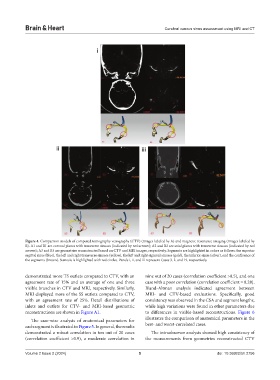
            Figure 4. Comparison models of computed tomography venography (CTV) (images labeled by A) and magnetic resonance imaging (images labeled by
            B). A1 and B1 are coronal planes with transverse sinuses (indicated by red arrows); A2 and B2 are axial planes with transverse sinuses (indicated by red
            arrows); A3 and B3 are geometries reconstructed based on CTV and MRI images, respectively. Segments are highlighted in colors as follows: the superior
            sagittal sinus (blue), the left and right transverse sinuses (yellow), the left and right sigmoid sinuses (gold), the inferior sinus (silver), and the confluence of
            the segments (brown). Stenosis is highlighted with red circles. Panels i, ii, and iii represent Cases 3, 2, and 19, respectively.


            demonstrated more TS outlets compared to CTV, with an   nine out of 20 cases (correlation coefficient >0.5), and one
            agreement rate of 15% and an average of one and three   case with a poor correlation (correlation coefficient = 0.28).
            visible branches in CTV and MRI, respectively. Similarly,   Bland-Altman analysis indicated agreement between
            MRI displayed more of the SS outlets compared to CTV,   MRI-  and CTV-based evaluations. Specifically, good
            with an agreement rate of 25%. Detail distributions of   consistency was observed in the CSA and segment lengths,
            inlets and outlets for CTV-  and MRI-based geometric   while high variations were found in other parameters due
            reconstructions are shown in Figure A1.            to differences in visible-based reconstructions.  Figure  6
                                                               illustrates the comparison of anatomical parameters in the
              The case-wise analysis of anatomical parameters for
            each segment is illustrated in Figure 5. In general, the results   best- and worst-correlated cases.
            demonstrated a robust correlation in ten out of 20 cases   The intraobserver analysis showed high consistency of
            (correlation coefficient >0.9), a moderate correlation in   the measurements from geometries reconstructed CTV


            Volume 2 Issue 2 (2024)                         5                                doi: 10.36922/bh.2756

