


Page 57 - DP-2-1
P. 57
Design+                                                                    Importance of material selection


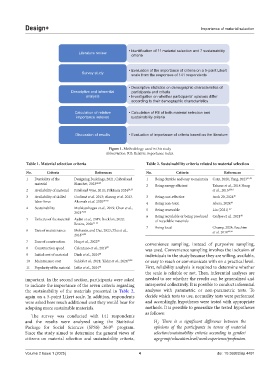
                                                        • Identification of 11 material selection and 7 sustainability
                                   Literature review
                                                          criteria

                                                        • Evaluation of the importance of criteria on a 5-point Likert
                                    Survey study          scale from the responses of 141 respondents

                                                        • Descriptive statistics on demographic characteristics of
                               Descriptive and inferential    participants and criteria
                                      analysis          • Investigation on whether participants' opinions differ
                                                         according to their demographic characteristics

                                 Calculation of relative  • Calculation of RII of both material selection and
                                  importance indexes      sustainability criteria


                                 Discussion of results  • Evaluation of importance of criteria based on the literature


                                               Figure 1. Methodology used in this study
                                              Abbreviation: RII: Relative importance index.

            Table 1. Material selection criteria               Table 2. Sustainability criteria related to material selection
            No.      Criteria            References            No.          Criteria            References
            1   Durability of the   Designing Buildings, 2021; Cabral and   1  Being durable and easy to maintain  Carp, 2020; Yang, 2023 41,42
                material         Blanchet, 2023 22,23          2   Being energy efficient  Takano et al., 2014 Hong
            2   Availability of material   Patel and Vyas, 2011; Pitkänen 2024 24,25       et al., 2015 43,44
            3   Availability of skilled   Gudienė et al. 2013; Alawag et al. 2023.   3  Being cost-effective  Arch 20, 2024 45
                labor force      Akomah et al. 2020 26-28      4   Being non-toxic         Abera, 2024 46
            4   Sustainability   Mathiyazhagan et al., 2019; Chen et al.,   5  Being renewable  Lin (2021)
                                                                                                   47
                                 2021 29,30                                                            48
            5   Esthetics of the material   Aydin et al., 2019; Rockfon, 2022;   6  Being recyclable or being produced  Cudjoe et al., 2021
                                                                   of recyclable materials
                                 Besten, 2020 31-33
                                                               7   Being local             Champ, 2024; Ibuchim
            6   Ease of maintenance   Mohanta, and Das, 2023; Zhu et al.,                  et al. 2010 49,50
                                 2018 34,35
            7   Ease of construction   Haq et al., 2022 36     convenience sampling, instead of purposive sampling,
            8   Construction speed   Celentano et al., 2019    was used. Convenience sampling involves the inclusion of
                                              37
            9   Initial cost of material   Dinh et al., 2024 38  individuals in the study because they are willing, available,
            10  Maintenance cost   Sahlol et al., 2021; Yıldız et al., 2024 12,39  or easy to reach or communicate with on a practical level.
            11  Popularity of the material  Jaffar et al., 2024 40  First, reliability analysis is required to determine whether
                                                               the scale is reliable or not. Then, inferential analyses are
            important. In the second section, participants were asked   needed to see whether the results can be generalized and
            to indicate the importance of the seven criteria regarding   interpreted collectively. It is possible to conduct inferential
            the sustainability of the materials presented in  Table  2,   analyses with parametric or non-parametric tests. To
            again on a 5-point Likert scale. In addition, respondents   decide which tests to use, normality tests were performed
            were asked how much additional cost they would bear for   and accordingly, hypotheses were tested with appropriate
            adopting more sustainable materials.               methods. It is possible to generalize the tested hypotheses
                                                               as follows:
              The survey was conducted with 141 respondents
            and the results were analyzed using the Statistical   H :  There is  a significant  difference  between the
                                                                    o
            Package for Social Sciences (SPSS) 26.0  program.     opinions of the participants in terms of material
                                                51
            Since the study aimed to determine the general views of   selection/sustainability criteria according to gender/
            citizens on material selection and sustainability criteria,   age group/education level/work experience/profession.

            Volume 2 Issue 1 (2025)                         4                                 doi: 10.36922/dp.4491

