


Page 61 - DP-2-1
P. 61
Design+                                                                    Importance of material selection


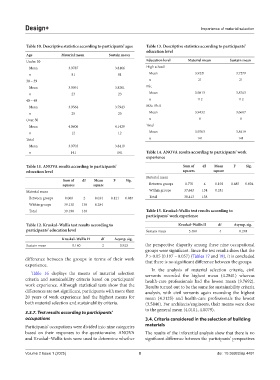
            Table 10. Descriptive statistics according to participants’ ages  Table 13. Descriptive statistics according to participants’
                                                               education level
            Age            Material mean       Sustain mean
            Under 30                                           Education level   Material mean     Sustain mean
             Mean             3.9787              3.8166       High school
             n                 81                  81           Mean                3.9221           3.7279
            30 – 39                                             n                    21                21
             Mean             3.9091              3.8261       BSc
             n                 23                  23           Mean                3.9813           3.8763
            40 – 49                                             n                    112              112
             Mean             3.9564              3.7943       MSc-PhD
             n                 25                  25           Mean                3.9432           3.6607
            Over 50                                             n                     8                8
             Mean             4.0606              4.1429       Total
             n                 12                  12           Mean                3.9703           3.8419
            Total                                               n                    141              141
             Mean             3.9703              3.8419
             n                 141                 141         Table 14. ANOVA results according to participants’ work
                                                               experience
            Table 11. ANOVA results according to participants’                 Sum of   df  Mean    F     Sig.
            education level                                                    squares      square
                                                               Material mean
                            Sum of   df  Mean    F     Sig.
                            squares      square                 Between groups  0.770   4    0.192  0.685  0.604
            Material mean                                       Within groups  37.643  134   0.281
             Between groups  0.068   2   0.034  0.121  0.887    Total          38.413  138
             Within groups  39.130  138  0.284
             Total          39.198  140                        Table 15. Kruskal–Wallis test results according to
                                                               participants’ work experience

            Table 12. Kruskal–Wallis test results according to               Kruskal–Wallis H  df    Asymp. sig.
            participants’ education level                      Sustain mean      5.480        4        0.241

                           Kruskal–Wallis H  df   Asymp. sig.
            Sustain mean        0.160       2       0.923      the perspective disparity among these nine occupational
                                                               groups were significant. Since the test results show that the
                                                               P > 0.05 (0.197 – 0.057) (Tables 17 and 18), it is concluded
            difference between the groups in terms of their work   that there is no significant difference between the groups.
            experience.
                                                                 In the analysis of material selection criteria, civil
              Table  16 displays the means of material selection   servants recorded the highest mean (4.2841) whereas
            criteria and sustainability criteria based on  participants’   health-care professionals had the lowest mean (3.7692).
            work experience. Although statistical tests show that the   Results turned out to be the same for sustainability criteria
            differences are not significant, participants with more than   analysis, with civil servants again recording the highest
            20  years  of  work  experience  had  the  highest  means  for   mean (4.3125) and health-care professionals the lowest
            both material selection and sustainability criteria.  (3.5846). For architects/engineers, their means were close
                                                               to the general mean (4.0101, 4.0079).
            3.3.7. Test results according to participants’
            occupations                                        3.4. Criteria considered in the selection of building
            Participants’ occupations were divided into nine categories   materials
            based on their responses to the questionnaire. ANOVA   The results of the inferential analysis show that there is no
            and Kruskal–Wallis tests were used to determine whether   significant difference between the participants’ perspectives


            Volume 2 Issue 1 (2025)                         8                                 doi: 10.36922/dp.4491

