


Page 62 - DP-2-1
P. 62
Design+                                                                    Importance of material selection


            regarding both material selection and sustainability criteria   important, 3 – Average important, 4 – Very important,
            according to any demographic characteristics. In this case, it is   and 5 – Absolutely very important;
            possible to generalize by determining the relative importance   •   A: The highest weight value (it is five in this case);
            coefficients of the criteria. The following formula was used to   •   N: Total number of participants (it is 141 in this case).
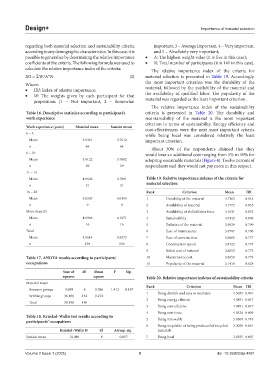
            calculate the relative importance index of the criteria:  The relative importance index of the criteria for

            IRI = ΣW/A*N                                (I)    material selection is presented in  Table  19. Accordingly,
            Where:                                             the most important criterion was the durability of the
            •   IRI: Index of relative importance;             material, followed by the availability of the material and
            •   W: The weights given by each participant for that   the availability of qualified labor. The popularity of the
               proposition (1 – Not important, 2 – Somewhat    material was regarded as the least important criterion.
                                                                 The relative  importance  index  of the sustainability
            Table 16. Descriptive statistics according to participant’s   criteria is presented in  Table  20. The durability and
            work experience                                    maintainability of the material is the  most important
                                                               criterion in terms of sustainability. Energy efficiency and
            Work experience (years)  Material mean  Sustain mean  cost-effectiveness were the next most important criteria
            0 – 5                                              while being local was considered relatively the least
             Mean                   3.9361         3.7612      important criterion.
             n                        64            64           About 30% of the respondents claimed that they
            6 – 10                                             would bear an additional cost ranging from 5% to 10% for
             Mean                   3.9122         3.7882      adopting sustainable materials (Figure 4). Twelve percent of
             n                        29            29         respondents said they would not pay more in this respect.
            11 – 15
             Mean                   4.0606         3.7891      Table 19. Relative importance indexes of the criteria for
             n                        21            21         material selection
            16 – 20                                            Rank            Criterion         Mean     IRI
             Mean                   3.8283         4.0159      1        Durability of the material   4.7163  0.943
             n                        9             9          2        Availability of material   4.1773  0.835
            More than 20                                       3        Availability of skilled labor force   4.1631  0.833
             Mean                   4.0966         4.1071      4        Sustainability           4.0142  0.803
             n                        16            16         5        Esthetics of the material   3.9929  0.799
            Total                                              6        Ease of maintenance      3.9787  0.796
             Mean                   3.9614         3.8273      7        Ease of construction     3.8865  0.777
             n                       139            139        8        Construction speed       3.8723  0.774
                                                               9        Initial cost of material   3.8652  0.773
            Table 17. ANOVA results according to participants’   10     Maintenance cost         3.8652  0.773
            occupations                                        11       Popularity of the material   3.1418  0.628

                            Sum of   df  Mean    F     Sig.
                            squares      square                Table 20. Relative importance indexes of sustainability criteria
            Material mean
                                                               Rank             Criterion           Mean  IRI
             Between groups  3.090   8   0.386  1.412  0.197
                                                               1    Being durable and easy to maintain  4.5035 0.901
             Within groups  36.108  132  0.274
             Total          39.198  140                        2    Being energy efficient          4.0851 0.817
                                                               3    Being cost-effective            4.0851 0.817
                                                               4    Being non-toxic                 4.0426 0.809
            Table 18. Kruskal–Wallis test results according to
            participants’ occupations                          5    Being renewable                 3.8369 0.767
                                                               6    Being recyclable or being produced of recycled   3.3050 0.661
                          Kruskal–Wallis H  df    Asymp. sig.       materials
            Sustain mean       15.086       8       0.057      7    Being local                     3.0355 0.607


            Volume 2 Issue 1 (2025)                         9                                 doi: 10.36922/dp.4491

