


Page 58 - DP-2-1
P. 58
Design+                                                                    Importance of material selection


              The statistical analyses used in the study were descriptive   participants have 0 – 5 years of work experience. In terms of
            analysis, reliability analysis, independent sample  t-test,   occupation, 34% of the participants are students, whereas
            analysis of variance (ANOVA), Mann–Whitney U test, and   the rest are architects, engineers, health professionals, civil
            Kruskal–Wallis test.                               servants, and tradesmen.
            3. Findings                                        3.2. Descriptive statistics and reliability analysis
                                                               results of the scales
            According  to  the  results  of  the  survey,  participants’
            demographic data, reliability of the scales, and whether   Reliability analysis is the process of evaluating the
            the opinions of the participants differed according to their   consistency of a scale or measurement instrument.
            demographic data were examined. The relative importance   The objective is to determine whether a scale produces
            of material selection criteria and material sustainability   consistent results under consistent conditions following
            criteria were determined.                          multiple administrations.  Cronbach’s  alpha is  the most
                                                               often used measure of internal consistency (or “reliability”).
            3.1. Demographic findings                          It is most used in surveys and questionnaires with multiple
            A data set can be quantified and summarized using   Likert questions that add up to a scale. Cronbach’s alpha
            descriptive analysis by counting or ranking values in a   is calculated by comparing the scores of each scale item
            quantitative or graphical format, or using quantitative   to the total score for each observation.  Table 3 displays
                                                                                               53
            numerical  values.   Descriptive  statistics  were  used  to   the reliability coefficients and descriptive data for the
                          52
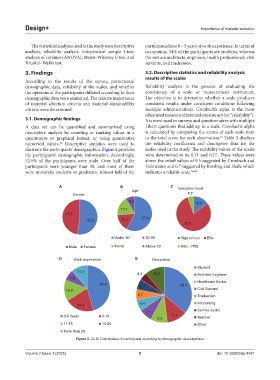
            illustrate the participants’ demographics. Figure 2 provides   scales used in the study. The reliability values of the scales
            the participants’ demographic information. Accordingly,   were determined to be 0.71 and 0.77. These values were
            52.5% of the participants were male. Over half of the   above the cutoff values of 0.5 suggested by Cronbach and
            participants  were  younger  than  30,  and most of  them   Helmstater and 0.7 suggested by Bowling and Shah, which
            were university students or graduates. Almost half of the   indicates a reliable scale. 54-56


                          A                         B                     C  Education level
                                                         Age
                                Gender                                           5.7
                                                        8.5                         14.9
                                                    17.7
                             47.5
                                      52.5          16.3     57.4
                                                                               79.4

                                                  Under 30     30-39          High school  BSc

                              Male   Female       40-49        Above 50       MSc - PhD

                          D     Work experience            E      Occupation
                                                                                     Student
                                  11.3                     4.3    10.6               Architect Engineer
                               7.8
                                           45.4              5.7              34.0   Healthcare Sector
                             14.9                                                    Civil Servant
                                                            5.7                      Tradesmen
                                  20.6                       6.4                     Accounting
                                                               7.1                   Service sector
                            0-5 Years       6-10                    9.2   11.4       Teacher
                            11-15           16-20                                    Other
                            More than 20
                                 Figure 2. (A-E) Distribution of participants according to demographic characteristics


            Volume 2 Issue 1 (2025)                         5                                 doi: 10.36922/dp.4491

