


Page 60 - DP-2-1
P. 60
Design+                                                                    Importance of material selection


                          A             Material selection     B              Sustainability
                           4.0      3.956          3.986        4.0
                           3.9                                  3.9      3.867          3.815
                           3.8                                  3.8
                           3.7                                  3.7
                           3.6                                  3.6
                           3.5                                  3.5
                           3.4                                  3.4
                           3.3                                  3.3
                           3.2                                  3.2
                           3.1                                  3.1
                           3.0                                  3.0
                                    Male          Female                 Male          Female
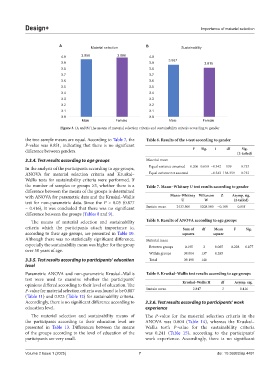
                           Figure 3. (A and B) The means of material selection criteria and sustainability criteria according to gender

            the two sample means are equal. According to Table 7, the   Table 6. Results of the t‑test according to gender
            P-value was 0.851, indicating that there is no significant
            difference between genders.                                            F   Sig.  t   df     Sig.
                                                                                                      (2‑tailed)
            3.3.4. Test results according to age groups        Material mean
            In the analysis of the participants according to age groups,   Equal variance assumed  0.206 0.650 −0.342  139  0.733
            ANOVA for material selection criteria and Kruskal–  Equal variance not assumed  −0.343 138.359  0.732
            Wallis tests for sustainability criteria were performed. If
            the number of samples or groups ≥3, whether there is a   Table 7. Mann–Whitney U test results according to gender
            difference between the means of the groups is determined
            with ANOVA for parametric data and the Kruskal–Wallis         Mann–Whitney  Wilcoxon   Z  Asymp. sig.
            test  for  non-parametric  data.  Since  the  P  >  0.05  (0.877   U        W           (2‑tailed)
            – 0.416), it was concluded that there was no significant   Sustain mean  2433.500  5208.500  −0.188  0.851
            difference between the groups (Tables 8 and 9).
              The means of material selection and sustainability   Table 8. Results of ANOVA according to age groups
            criteria which the participants attach importance to,              Sum of   df  Mean    F     Sig.
            according to their age groups, are presented in Table 10.          squares      square
            Although there was no statistically significant difference,   Material mean
            especially the sustainability mean was higher for the group   Between groups  0.195  3  0.065  0.228  0.877
            over 50 years of age.
                                                                Within groups  39.004  137  0.285
            3.3.5. Test results according to participants’ education   Total   39.198  140
            level
            Parametric ANOVA and non-parametric Kruskal–Wallis   Table 9. Kruskal–Wallis test results according to age groups
            test were used to examine whether the participants’                Kruskal–Wallis H  df  Asymp. sig.
            opinions differed according to their level of education. The
            P-value for material selection criteria was found to be 0.887   Sustain mean  2.847  3     0.416
            (Table 11) and 0.923 (Table 12) for sustainability criteria.
            Accordingly, there is no significant difference according to   3.3.6. Test results according to participants’ work
            education level.                                   experience
              The material selection and sustainability means of   The  P-value for the material selection criteria in the
            the  participants  according  to  their  education  level  are   ANOVA was 0.604 (Table  14), whereas the Kruskal–
            presented in  Table  13. Differences  between the means   Wallis test’s  P-value for the sustainability criteria
            of the groups according to the level of education of the   was 0.241 (Table  15), according to the participants’
            participants are very small.                       work experience. Accordingly, there is no significant


            Volume 2 Issue 1 (2025)                         7                                 doi: 10.36922/dp.4491

