


Page 59 - DP-2-1
P. 59
Design+                                                                    Importance of material selection


            3.3. Relationships between demographic variables   data was 141, the Kolmogorov–Smirnov test results were
            and material selection criteria                    taken as basis. In the Kolmogorov–Smirnov test, a P > 0.05
            The main purpose of the study is to determine the   indicates normal distribution, while a P < 0.05 indicates
                                                                                   60
            importance levels of material selection criteria and   non-normal distribution.  The results of the Kolmogorov–
            sustainability criteria. For this, it is first necessary to reveal   Smirnov test are displayed in Table 5. This indicates that
            whether the participants’ opinions differ according to their   the sustainability criteria data exhibits a non-normal
            demographic characteristics. A normality test was carried   distribution, whereas  the material selection criteria data
            out since the tests to be used were chosen based on whether   exhibits a normal distribution. According to these results,
            the data were normally distributed.                it would be appropriate to proceed with parametric tests
                                                               for the normally distributed material selection criteria data
            3.3.1. Normality test                              and nonparametric tests for the non-normally distributed
                                                               sustainability criteria data.
            Several techniques can be used to determine whether the
            data are normally distributed. Using one of these methods,   3.3.2. Inferential analysis results
            we determined the statistics value or standard error value
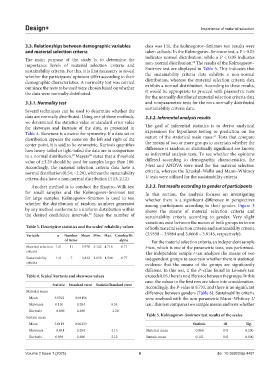
            for skewness and kurtosis of the data, as presented in   The goal  of  inferential  statistics  is to  derive  analytical
            Table 4. Skewness is a metric for symmetry. If a data set or   expressions for hypothesis testing or prediction on the
                                                                                            61
            distribution appears the same on the left and right of the   nature of the statistical main mass.  Tests that compare
            center point, it is said to be symmetric. Kurtosis quantifies   the means of two or more groups to ascertain whether the
            how heavy-tailed or light-tailed the data are in comparison   difference is random or statistically significant are known
            to a normal distribution. Mayers  states that a threshold   as inferential analysis tests. To see whether the opinions
                                       58
                                57
            value of ±3.29 should be used for samples larger than 100.   differed according to demographic characteristics, the
            Accordingly, the material selection criteria data have a   t-test and ANOVA were used for the material selection
            normal distribution (0.54; −2.20), whereas the sustainability   criteria, whereas the Kruskal–Wallis and Mann–Whitney
            criteria data have a non-normal distribution (4.13; 2.12).  U tests were utilized for the sustainability criteria.
              Another method is to conduct the Shapiro–Wilk test   3.3.3. Test results according to gender of participants
            for small samples and the Kolmogorov–Smirnov test   In  this  section,  the  analysis  focuses  on  investigating
            for large samples. Kolmogorov–Smirnov is used to test   whether there is a significant difference in perspectives
            whether  the  distribution  of random numbers generated   among participants according to their gender.  Figure  3
            by any method conforms to a uniform distribution within   shows the means of material selection criteria and
            the desired confidence intervals.  Since the number of   sustainability  criteria according to  gender. Very slight
                                       59
                                                               variations exist between the means of both groups in terms
            Table 3. Descriptive statistics and the scales’ reliability values  of both material selection criteria and sustainability criteria

            Variable     n  Number  Mean Min. Max. Cronbach’s   (3.9558 – 3.9864 and 3.8668 – 3.8145, respectively).
                             of items               alpha        For the material selection criteria, an independent sample
            Material selection  141  11  3.970 3.142 4.716  0.71  t-test, which is one of the parametric tests, was performed.
            criteria                                           The independent sample t-test analyzes the means of two
            Sustainability   141  7  3.842 3.035 4.504  0.77   independent groups to ascertain whether there is statistical
            criteria                                           evidence that the means of the groups are significantly
                                                               different. In this test, if the P-value found in Levene’s test
            Table 4. Scales’ kurtosis and skewness values      exceeds 0.05, there is no difference between the groups. In this
                                                               case, the values in the first row are taken into consideration.
                       Statistic Standard error  Statistic/Standard error  Accordingly, the P-value is 0.733, and there is no significant
            Material mean                                      difference between genders (Table 6). Sustainability criteria
             Mean       3.9703   0.04456                       were analyzed with the non-parametric Mann–Whitney U
             Skewness    0.110    0.204         0.54           test. This test compares two sample means and tests whether
             Kurtosis   −0.896    0.406         −2.20
                                                               Table 5. Kolmogorov–Smirnov test results of the scales
            Sustain mean
             Mean       3.8419   0.06353                                           Statistic    df        Sig.
             Skewness   −0.844    0.204         4.13           Material mean        0.060       141      0.200
             Kurtosis    0.859    0.406         2.12           Sustain mean         0.111       141      0.000


            Volume 2 Issue 1 (2025)                         6                                 doi: 10.36922/dp.4491

