


Page 28 - DP-2-2
P. 28
Design+                                                                   Climate-adaptive clothing design


            processes. Prioritizing sustainability not only mitigates   5. Climate-adaptive clothing system:
            the environmental impact of climate change but     Enhancing resilience in a changing climate
            also contributes to broader efforts in environmental
            conservation and social responsibility. Thermal regulation   Climate change presents unprecedented challenges to
            is a fundamental aspect of climate-adaptive clothing   human health, necessitating innovative solutions to
            systems, essential for ensuring the comfort, safety, and   mitigate its adverse effects. Among these solutions, climate-
            well-being of the wearer under varying environmental   adaptive  clothing  systems  have  emerged  as  a  promising
                                                               avenue for enhancing resilience and well-being in the face
            conditions. By integrating thermoregulatory  fabrics,                                      29
            ventilation  systems,  adaptive  design  features,  and   of increasingly variable environmental conditions.  These
                                                               systems represent a proactive approach to addressing the
            sustainable practices, these innovative garments empower   specific challenges posed by climate change, equipping
            individuals to adapt and thrive in a changing climate.   individuals with tools to adapt and thrive in a dynamic
            Understanding the principles of thermal regulation is   climate. By integrating advanced textiles, functional design
            essential for designers, policymakers, and consumers   features, and sustainable manufacturing practices, climate-
            alike,  as  they  collaborate  to  promote  resilience  and   adaptive clothing systems offer a comprehensive solution
            sustainability in the face of climate change.      for mitigating the impact of climate change on human

              Clothing insulation is another key factor in enhancing   health.
            thermal comfort, as it helps retain body heat and serves   One  of  the  central components of  climate-adaptive
            as a barrier against cold weather. Insulating fabrics, such   clothing systems is the use of thermoregulatory fabrics,
            as  down,  wool, and  synthetic  fibers, are  designed  to   which are engineered to optimize thermal comfort by
            balance warmth and breathability, allowing perspiration   balancing heat retention and dissipation according to the
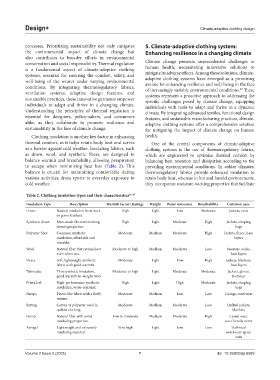
            to escape when minimizing heat loss (Table  2). This   prevailing environmental conditions. In colder climates,
            balance is crucial for maintaining comfortable during   thermoregulatory fabrics provide enhanced insulation to
            various activities, from sports to everyday exposure to   retain body heat, whereas in hot and humid environments,
            cold weather.                                      they incorporate moisture-wicking properties that facilitate

            Table 2. Clothing insulation types and their characteristics 26‑28

            Insulation Type    Description    Warmth factor (Rating)  Weight  Water resistance  Breathability  Common uses
            Down         Natural insulation from duck   High      Light     Low        Moderate   Jackets, vests
                         or goose feathers.
            Synthetic down  Man-made fibers mimicking   High      Light   Moderate      High     Jackets, sleeping
                         down’s properties.                                                          bags
            Polyester fiber  Common synthetic      Moderate     Medium    Moderate      High    Jackets, fleece, base
                         insulation, affordable and                                                  layers
                         versatile.
            Wool         Natural fiber that retains heat   Moderate to high  Medium  Moderate  Low  Sweaters, socks,
                         even when wet.                                                            base layers
            Fleece       Soft, lightweight synthetic   Moderate   Light     Low         High     Jackets, blankets,
                         fabric with good warmth.                                                  base layers
            Thinsulate   Thin synthetic insulation,   Moderate to high  Light  Moderate  Moderate  Jackets, gloves,
                         good warmth-to-weight ratio.                                               footwear
            PrimaLoft    High-performance synthetic   High        Light     High       Moderate  Jackets, sleeping
                         insulation, water-resistant.                                                bags
            Sherpa       Fleece-like fabric with a fluffy   Moderate  Medium  Low       Low      Linings, outerwear
                         texture.
            Batting      Cotton or polyester used in   Moderate  Medium   Moderate      Low       Quilted jackets,
                         quilted clothing.                                                          blankets
            Hemp         Natural fiber with some   Low to moderate  Medium  Moderate    High       Casual wear,
                         insulating properties.                                                  eco-friendly items
            Aerogel      Lightweight and extremely   Very high    Light     Low         Low        Technical
                         insulating material.                                                    outerwear, space
                                                                                                     suits


            Volume 2 Issue 2 (2025)                         7                                doi: 10.36922/dp.8589

