


Page 27 - DP-2-2
P. 27
Design+                                                                   Climate-adaptive clothing design


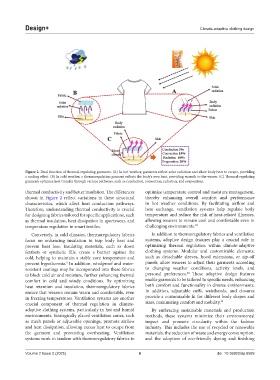
            Figure 2. Dual function of thermal-regulating garments. (A) In hot weather, garments reflect solar radiation and allow body heat to escape, providing
            a cooling effect. (B) In cold weather, a thermoregulation garment reflects the body’s own heat, providing warmth to the wearer. (C) Thermal-regulating
            garments optimize heat transfer through various pathways, such as conduction, convection, radiation, and evaporation.
            thermal conductivity and better insulation. The differences   optimize temperature control and moisture management,
            shown in  Figure  2 reflect variations in these structural   thereby enhancing overall comfort and performance
            characteristics, which affect heat conduction pathways.   in hot weather conditions. By facilitating airflow and
            Therefore, understanding thermal conductivity is crucial   heat exchange, ventilation systems help regulate body
            for designing fabrics tailored for specific applications, such   temperature and reduce the risk of heat-related illnesses,
            as thermal insulation, heat dissipation in sportswear, and   allowing wearers to remain cool and comfortable even in
            temperature regulation in smart textiles.          challenging environments. 23

              Conversely, in cold climates, thermoregulatory fabrics   In addition to thermoregulatory fabrics and ventilation
            focus on enhancing insulation to trap body heat and   systems, adaptive design features play a crucial role in
            prevent heat loss. Insulating materials, such as down   optimizing  thermal regulation within climate-adaptive
            feathers or synthetic fills, create a barrier against the   clothing systems. Modular and customizable elements,
            cold, helping to maintain a stable core temperature and   such as detachable sleeves, hood extensions, or zip-off
            prevent hypothermia.  In addition, windproof and water-  panels, allow wearers to adjust their garments according
                             9
            resistant coatings may be incorporated into these fabrics   to changing weather conditions, activity levels, and
                                                                                 24
            to block cold air and moisture, further enhancing thermal   personal preferences.  These adaptive design features
            comfort in cold and windy conditions. By optimizing   enable garments to be tailored to specific needs, enhancing
            heat retention and insulation, thermoregulatory fabrics   both comfort and functionality in diverse environments.
            ensure that wearers remain warm and comfortable, even   In addition, adjustable cuffs, waistbands, and closures
            in freezing temperatures. Ventilation systems are another   provide a customizable fit for different body shapes and
            crucial component of thermal regulation in climate-  sizes, maximizing comfort and mobility. 25
            adaptive clothing systems, particularly in hot and humid   By embracing sustainable materials and production
            environments. Strategically placed ventilation zones, such   methods, these systems minimize their environmental
            as mesh panels or adjustable openings, promote airflow   impact  and promote  circularity  within  the  fashion
            and heat dissipation, allowing excess heat to escape from   industry. This includes the use of recycled or renewable
            the garment and preventing overheating. Ventilation   materials, the reduction of waste and energy consumption,
            systems work in tandem with thermoregulatory fabrics to   and the adoption of eco-friendly dyeing and finishing


            Volume 2 Issue 2 (2025)                         6                                doi: 10.36922/dp.8589

