


Page 40 - DP-2-2
P. 40
Design+                                                          EV charging capacity through queuing model


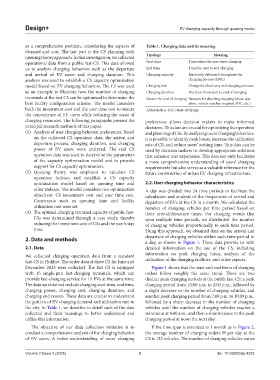
            as  a  comprehensive  problem,  considering  the  aspects  of   Table 1. Charging data and its meaning
            demand and cost. The last part is the CS planning with
            queuing theory approach. In this investigation, we collected   Typology         Meaning
            operational data from a public fast-CS. This data allowed   Start time  Time when the user starts charging
            us to analyze charging behaviors such as the departure   End time    Time for user to end charging
            and arrival of EV users and charging duration. This   Charging capacity  Electricity delivered throughout the
            analysis was used to establish a CS capacity optimization            charging process (kWh)
            model based on EV charging behaviors. The CS was used   Charging fees  Charge for electricity and charging services
            as an example to illustrate how the number of charging   Charging duration  Duration from start to end of charging
            terminals at the fast CS can be optimized to determine the   Reason for end of charging Reasons for aborting charging (draw, app
            best facility configuration scheme. The model considers              abort, vehicle reaches required SOC, etc.)
            both the investment cost and the user time cost to ensure   Abbreviation: SOC: State of charge.
            the convenience of EV users while reducing the waste of
            charging resources. The following paragraphs present the   preferences allows decision makers to make informed
            principal research methods of this paper.          decisions. This data are crucial for optimizing the operation
            (1)  Analysis of user charging behavior preferences. Based   and planning of CSs. By analyzing users’ charging behaviors,
               on  the collected  CS  operation data,  the  arrival and   it is possible to identify peak hours, increase the utilization
               departure process, charging duration, and charging   rate of CS, and reduce users’ waiting time. This data can be
               power of EV users were analyzed. The real CS    used by decision makers to develop appropriate solutions
               operation data was used to determine the parameters   that enhance user experience. This data not only facilitates
               of the capacity optimization model and to provide   a more comprehensive understanding of users’ charging
               support for CS capacity optimization.           requirements but also serves as a valuable reference for the
            (2)  Queuing theory was employed to calculate CS   future construction of urban EV charging infrastructure.
               operation indexes and establish a CS capacity
               optimization model based on queuing time and    2.2. User charging behavior characteristics
               other indexes. The model considers two optimization   A day was divided into 24 time periods to facilitate the
               objectives: CS investment cost and user time cost.   calculation and analysis of the frequencies of arrival and
               Constraints such as queuing time and facility   departure of EVs at the CS in a month. We calculated the
               utilization rate were set.                      number  of  charging  vehicles  per  time  period  based  on
            (3)  The optimal charging terminal capacity of public fast-  their arrival/departure times. For charging events that
               CSs was determined through a case study, thereby   span multiple time periods, we distributed the number
               reducing the investment cost of CSs and the user’s stay   of charging vehicles proportionally to each time period.
               time.                                           Using this approach, we obtained data on the arrival and

            2. Data and methods                                departure of charging vehicles within each time period in
                                                               a day, as shown in Figure 1. These data provide us with
            2.1. Data                                          detailed information on the use of the CS, including
            We collected charging operation data from a standard   information on peak charging times, analysis of the
            fast-CS in Hohhot. The order data at three CS for June and   utilization of the charging facilities, and other aspects.
            December 2023 were collected. The fast CS is equipped   Figure 1 shows that the start and end times of charging
            with  15 single-gun  fast-charging  terminals,  which  can   orders follow roughly the same trend. There are two
            provide fast-charging service for 15 EVs at the same time.   distinct peak charging periods at the public fast-CS: a peak
            The data we obtained include charging start time, end time,   charging period from 10:00 a.m. to 2:00 p.m., followed by
            charging power, charging cost, charging duration, and   a slight decrease in the number of charging vehicles, and
            charging end reason. These data are crucial to understand   another peak charging period from 7:00 p.m. to 10:00 p.m.,
            the pattern of EV charging demand and utilization rate in   followed by a sharp decrease in the number of charging
            the city. In Table 1, we describe in detail each of the data   vehicles until the number of charging vehicles reaches a
            collected and their meanings to better understand and   minimum at 4:00 a.m., and then a slow increase to the peak
            utilize this information.                          charging period at noon the next day.
              The objective of our data collection initiative is to   If the time span is extended to 1 month as in Figure 2,
            conduct a comprehensive analysis of the charging behavior   the average number of charging orders H per day at the
            of EV users. A  better understanding of users’ charging   CS is 132 vehicles. The number of charging vehicles varies


            Volume 2 Issue 2 (2025)                         3                                doi: 10.36922/dp.4225

