


Page 42 - DP-2-2
P. 42
Design+                                                          EV charging capacity through queuing model


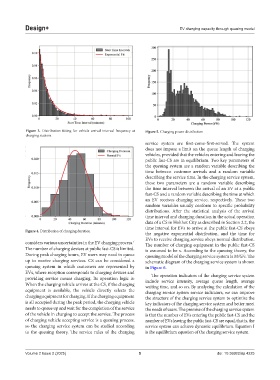
            Figure 3. Distribution fitting for vehicle arrival interval frequency at   Figure 5. Charging power distribution
            charging stations
                                                               service system are first-come-first-served. The system
                                                               does not impose a limit on the queue length of charging
                                                               vehicles, provided that the vehicles entering and leaving the
                                                               public fast-CS are in equilibrium. Two key parameters of
                                                               the queuing system are a random variable describing the
                                                               time between customer arrivals and a random variable
                                                               describing the service time. In the charging service system,
                                                               these two parameters are a random variable describing
                                                               the time interval between the arrival of an EV at a public
                                                               fast-CS and a random variable describing the time at which
                                                               an  EV  receives  charging  service,  respectively.  These  two
                                                               random variables usually conform to specific probability
                                                               distributions. After the statistical analysis of the arrival
                                                               time interval and charging duration in the actual operation
                                                               data of a CS in Hohhot City as described in Section 2.2, the
                                                               time interval for EVs to arrive at the public fast-CS obeys
            Figure 4. Distribution of charging duration
                                                               the negative exponential distribution, and the time for
                                                               EVs to receive charging service obeys normal distribution.
            considers various uncertainties in the EV charging process.    The number of charging equipment in the public fast-CS
                                                          1
            The number of charging devices at public fast-CS is limited.   is assumed to be s. According to the queuing theory, the
            During peak charging hours, EV users may need to queue   queuing model of the charging service system is M/G/s. The
            up to receive charging services. CS can be considered a   schematic diagram of the charging service system is shown
            queuing system in which customers are represented by   in Figure 6.
            EVs, where reception corresponds to charging devices and
                                                                 The operation indicators of the charging service system
            providing service means charging. Its operation logic is:   include service intensity, average queue length, average
            When the charging vehicle arrives at the CS, if the charging   waiting time, and so on. By analyzing the calculation of the
            equipment is available, the vehicle directly selects the   charging service system service indicators, we can improve
            charging equipment for charging. If the charging equipment   the structure of the charging service system to optimize the
            is all occupied during the peak period, the charging vehicle   key indicators of the charging service system and better meet
            needs to queue up and wait for the completion of the service   the needs of users. The premise of the charging service system
            of the vehicle in charging to accept the service. The process   is that the number of EVs entering the public fast-CS and the
            of charging vehicle accepting service is a queuing process,   number of EVs leaving the public fast-CS are equal, that is, the
            so the charging service system can be studied according   service system can achieve dynamic equilibrium. Equation I
            to the queuing theory. The service rules of the charging   is the equilibrium equation of the charging service system.


            Volume 2 Issue 2 (2025)                         5                                doi: 10.36922/dp.4225

