


Page 47 - DP-2-2
P. 47
Design+                                                          EV charging capacity through queuing model


            be >1 h. The charging waiting time for EV users is longer.
            Taking the above analysis into account, the maximum value
            of the number of charging terminals in a public fast-CS is
            13.  By considering  the  above two  constraints of  facility
            utilization rate and charging waiting time, the number of
            charging terminals in the capacity optimization model of
            public fast-CS is limited to between 6 and 13.

            3. Results
            In the previous section, the parameters of the public fast-CS
            capacity optimization model are set and the constraints
            are analyzed. After calculation, the optimal configuration
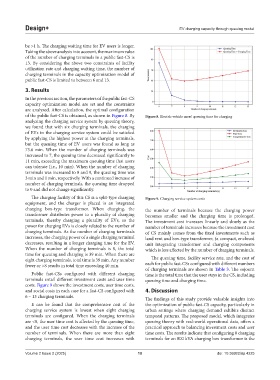
            of the public fast-CS is obtained, as shown in Figure 8. By   Figure 8. Electric vehicle users’ queuing time for charging
            analyzing the charging service system by queuing theory,
            we found that with six charging terminals, the charging
            of EVs in the charging service system could be satisfied
            by applying the highest power at the charging terminals,
            but the queuing time of EV users was found as long as
            73.6  min. When the number of charging terminals was
            increased to 7, the queuing time decreased significantly to
            11 min, exceeding the maximum queuing time that users
            can tolerate (i.e., 10 min). When the number of charging
            terminals was increased to 8 and 9, the queuing time was
            3 min and 1 min, respectively. With a continued increase of
            number of charging terminals, the queuing time dropped
            to 0 and did not change significantly.
              The charging facility of this CS is a split-type charging   Figure 9. Charging service system costs
            equipment, and the charger is placed in an integrated
            charging box-type transformer. When charging, the   the number of terminals because the charging power
            transformer distributes power to a plurality of charging   becomes smaller and the charging time is prolonged.
            terminals, thereby charging a plurality of EVs, so the   The investment cost increases linearly and slowly as the
            power for charging EVs is closely related to the number of   number of terminals increases because the investment cost
            charging terminals. As the number of charging terminals   of CS mainly comes from the fixed investments such as
            increases, the charging power of a single charging terminal   land rent and box-type transformer, (a compact, enclosed
            decreases, resulting in a longer charging time for the EV.   unit  integrating  transformer  and  charging  components
            When the number of charging terminals is 8, the total   which is less affected by the number of charging terminals.
            time for queuing and charging is 39 min. When there are
            eight charging terminals, total time is 39 min. Any number   The queuing time, facility service rate, and the cost of
            fewer or >8 results in total time exceeding 40 min.  each for public fast-CSs configured with different numbers
                                                               of charging terminals are shown in Table 3. The sojourn
              Public fast-CSs configured with different charging   time is the total time that the user stays in the CS, including
            terminals entail different investment costs and user time   queuing time and charging time.
            costs. Figure 9 shows the investment costs, user time costs,
            and social costs in each case for a fast-CS configured with   4. Discussion
            6 – 13 charging terminals.
                                                               The findings of this study provide valuable insights into
              It can  be found that  the comprehensive cost of  the   the optimization of public fast-CS capacity, particularly in
            charging service system is lowest when eight charging   urban settings where charging demand exhibits distinct
            terminals are configured. When the charging terminals   temporal patterns. The proposed model, which integrates
            are <8, the user time cost is affected by the queuing time,   queuing theory with real-world operational data, offers a
            and the user time cost decreases with the increase of the   practical approach to balancing investment costs and user
            number of terminals. When there are more than eight   time costs. The results indicate that configuring 8 charging
            charging terminals, the user time cost increases with   terminals for an 800 kVA charging box transformer is the


            Volume 2 Issue 2 (2025)                         10                               doi: 10.36922/dp.4225

