Page 43 - DP-2-2
P. 43

Design+                                                          EV charging capacity through queuing model


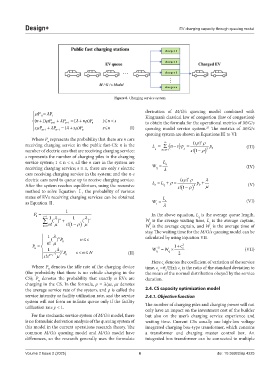
                                                  Figure 6. Charging service system


                µ  = P                                        derivation of  M/G/s queuing model combined with
                     λ   P
                  0   1                                       Kingman’s classical law of congestion (law of congestion)
                     µ+  (n  n +  λ + 1) P  n −1  1  ( λ = P  n µ +  )P n  1  < ns  to obtain the formula for the operational metrics of M/G/s
                 µ sP +   λ +  ( λ = P  s µ +  )P  s n  (I)  queuing model service system.  The metrics of  M/G/s
                                                                                         25
                   n
                          1
                                    n
                         n
                         −1
                                                               queuing system are shown in Equations III to VI:
              Where P  represents the probability that there are n cars
                     n
                                                                             )
            receiving charging service in the public fast-CS; n is the   = L  ∑  ∞  ( − n sp  =  (s ρρ) s  p  (III)
                                                                                   ( −
                                                                      =
            number of electric cars that are receiving charging service;   q  ns +1  n  s ! 1  ) ρ 2  0
            s represents the number of charging piles in the charging
            service system; 1 ≤ n < s, all the n cars in the system are   L q
            receiving charging service; s ≤ n, there are only s electric   W q  =  λ                      (IV)
            cars receiving charging service in the system; and the n-s
                                                                                )
                                                                                 s
            electric cars need to queue up to receive charging service.       (s ρ ρ    λ
            After the system reaches equilibrium, using the recursive   s  =L  q  +L  ρ =  s !1  ) ρ 2  0  +p  µ  (V)
                                                                              ( −
            method  to  solve  Equation  Ⅰ,  the  probability  of  various
            states of EVs receiving charging services can be obtained   L
                                                                       s
            as Equation Ⅱ.                                        W s  =  λ                               (VI)
                             1
               P  =                                              In the above equation, L  is the average queue length,
                0  s −1  1      1                                                    q
                   ∑   ()  +        ()                         W  is the average waiting time, L  is the average captain,
                                     λ s
                        λ n
                                                                                          s
                                                                 q
                              ( −
                   n =0 ! n  µ  s !1  ρ  ) µ                   W  is the average captain, and W  is the average time of
                                                                                          s
                                                                 s
                                                               stay. The waiting time for the M/G/s queuing model can be
                   1   λ n                                    calculated by using Equation VII.
                                     ≤
                     ! () P 0     ns
                   n
                        µ
               P n  =                                              G      1c  2 s
                                                                            +
                    1  () P     sn                    (II)       W q  =W q  ×  2                        (VII)
                                   <≤ N
                         λ s
                   ! ss ns  µ  0
                       −
                  
                                                                 Here c  denotes the coefficient of variation of the service
                                                                      s
              Where P  denotes the idle rate of the charging device   time, c  =σ /E(x); c  is the ratio of the standard deviation to
                      0
                                                                    s
                                                                              s
                                                                       s
            (the probability that there is no vehicle charging in the   the mean of the normal distribution obeyed by the service
            CS);  P  denotes the probability that exactly  n EVs are   duration.
                 n
            charging in the CS. In the formula, ρ = λ/μs, μs denotes
            the average service rate of the system, and ρ is called the   2.4. CS capacity optimization model
            service intensity or facility utilization rate, and the service   2.4.1. Objective function
            system will not form an infinite queue only if the facility   The number of charging piles and charging power will not
            utilization rate ρ < 1.
                                                               only have an impact on the investment cost of the builder
              For the stochastic service system of M/G/s model, there   but also on the user’s charging service experience and
            is no formulaic derivation analysis of the queuing system of   waiting  time.  Current  CSs  usually  use  high-low  voltage
            this model in the current operations research theory. The   integrated charging box-type transformer, which contains
            common  M/G/s queuing model and  M/G/s model have   a transformer and charging master control box. An
            differences, so the research generally uses the formulaic   integrated box transformer can be connected to multiple
            Volume 2 Issue 2 (2025)                         6                                doi: 10.36922/dp.4225
   38   39   40   41   42   43   44   45   46   47   48