


Page 48 - DP-2-2
P. 48
Design+                                                          EV charging capacity through queuing model


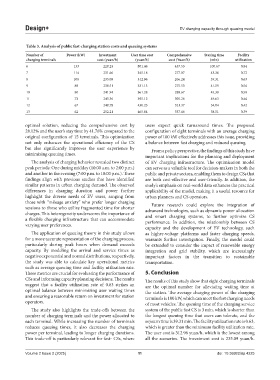
            Table 3. Analysis of public fast‑charging station costs and queuing systems
            Number of        Power (kW)    Investment    User time cost   Comprehensive   Staying time   Facility
            charging terminals            cost (yuan/h)    (yuan/h)      cost (Yuan/h)    (min)      utilization
            6                   133          228.23         801.46         457.53         100.67       0.84
            7                   114          231.66         345.18         277.07          43.36       0.72
            8                   100          235.09         312.96         266.24          39.31       0.63
            9                    89          238.51         331.13         275.53          41.59       0.56
            10                   80          241.94         361.28         289.67          45.38       0.50
            11                   73          245.36         395.12         305.26          49.63       0.46
            12                   67          248.78         430.25         321.37          54.04       0.42
            13                   62          252.21         465.84         337.66          58.51       0.39

            optimal solution, reducing the comprehensive cost by   users expect quick turnaround times. The proposed
            28.12% and the user’s stay time by 41.76% compared to the   configuration of eight terminals with an average charging
            original configuration of 15 terminals. This optimization   power of 100 kW effectively addresses this issue, providing
            not  only enhances  the  operational  efficiency  of  the  CS   a balance between fast charging and reduced queuing.
            but also significantly improves the user experience by   From a policy perspective, the findings of this study have
            minimizing queuing times.
                                                               important implications for the planning and deployment
              The analysis of charging behavior revealed two distinct   of EV charging infrastructure. The optimization model
            peak periods: One during midday (10:00 a.m. to 2:00 p.m.)   can serve as a valuable tool for decision-makers in both the
            and another in the evening (7:00 p.m. to 10:00 p.m.). These   public and private sectors, enabling them to design CSs that
            findings align with previous studies that have identified   are both cost-effective and user-friendly. In addition, the
            similar patterns in urban charging demand. The observed   study’s emphasis on real-world data enhances the practical
            differences in charging duration and power further   applicability of the model, making it a useful resource for
            highlight the diverse needs of EV users, ranging from   urban planners and CS operators.
            those with “mileage anxiety” who prefer longer charging   Future research could explore the integration of
            sessions to those who utilize fragmented time for shorter   advanced technologies, such as dynamic power allocation
            charges. This heterogeneity underscores the importance of   and smart charging systems, to further optimize CS
            a flexible charging infrastructure that can accommodate   performance. In addition, the relationship between CS
            varying user preferences.
                                                               capacity and the development of EV technology, such
              The application of queuing theory in this study allows   as higher-voltage platforms and faster charging speeds,
            for a more accurate representation of the charging process,   warrants further investigation. Finally, the model could
            particularly during peak hours when demand exceeds   be extended to consider the impact of renewable energy
            capacity. By modeling the arrival and service times as   integration and  grid  stability,  which  are increasingly
            negative exponential and normal distributions, respectively,   important factors in  the  transition  to sustainable
            the study was able to calculate key operational metrics   transportation.
            such as average queuing time and facility utilization rate.
            These metrics are crucial for evaluating the performance of   5. Conclusion
            CSs and informing capacity planning decisions. The results   The results of this study show that eight charging terminals
            suggest that a facility utilization rate of 0.63  strikes  an   are the optimal number for alleviating waiting time at
            optimal balance between minimizing user waiting times   the station. The average charging power of the charging
            and ensuring a reasonable return on investment for station   terminals is 100 kW, which can meet the fast charging needs
            operators.                                         of most vehicles. The queuing time of the charging service

              The study also highlights the trade-offs between the   system of the public fast CS is 3 min, which is shorter than
            number of charging terminals and the power allocated to   the longest queuing time that users can tolerate, and the
            each terminal. While increasing the number of terminals   sojourn time is 39.31 min. The facility utilization rate is 0.63,
            reduces queuing times, it also decreases the charging   which is greater than the minimum facility utilization rate.
            power per terminal, leading to longer charging durations.   The user cost is 312.96 yuan/h, which is the lowest among
            This trade-off is particularly relevant for fast- CSs, where   all  the  scenarios.  The  investment  cost  is  235.09 yuan/h.


            Volume 2 Issue 2 (2025)                         11                               doi: 10.36922/dp.4225

