


Page 27 - DP-2-3
P. 27
Design+                                                             Traditional handcrafting and sustainability


               Westwood have committed to transparent production   perceptions. These challenges arise from the disparity
               processes. They publish detailed reports on material   between the demand for rapid, mass production and
               sourcing and working conditions, thereby enhancing   the need to preserve sustainable, culturally embedded
               consumer trust. 138                             practices.
            •   Collaborations  with  designers:  Initiatives  such  as   •   Commercial and operational challenges: Traditional
               Fashion for Good bring together creators, consumers,   techniques  –  such  as  hand  weaving  and  natural
               and businesses to promote sustainable fashion      dyeing – typically require more time and specialized
               practices. By supporting innovative designers who   labor, resulting in higher production costs and
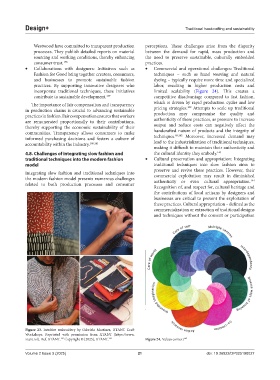
               incorporate traditional techniques, these initiatives   limited scalability (Figure  24). This creates a
               contribute to sustainable development. 139         competitive disadvantage compared to fast fashion,
              The importance of fair compensation and transparency   which is driven by rapid production cycles and low
                                                                                 102
            in production chains is crucial to advancing sustainable   pricing strategies.  Attempts to scale up traditional
            practices in fashion. Fair compensation ensures that workers   production may compromise the quality and
            are remunerated proportionally to their contributions,   authenticity of these practices, as pressure to increase
            thereby supporting the economic sustainability of their   output and reduce costs can negatively affect the
            communities.  Transparency  allows  consumers  to  make   handcrafted nature of products and the integrity of
                                                                            68,142
            informed purchasing decisions and fosters a culture of   techniques.    Moreover,  increased demand  may
            accountability within the industry. 140,141           lead to the industrialization of traditional techniques,
                                                                  making it difficult to maintain their authenticity and
            4.8. Challenges of integrating slow fashion and       the cultural identity they embody. 143
            traditional techniques into the modern fashion     •   Cultural preservation and appropriation: Integrating
            model                                                 traditional techniques into slow fashion aims to
                                                                  preserve and revive these practices. However, their
            Integrating slow fashion and traditional techniques into   commercial  exploitation  may  result  in  diminished
            the modern fashion model presents numerous challenges   authenticity or even cultural appropriation.
                                                                                                            144
            related to both production processes and consumer
                                                                  Recognition of, and respect for, cultural heritage and
                                                                  the contributions of local artisans by designers and
                                                                  businesses are critical to prevent the exploitation of
                                                                  these practices. Cultural appropriation – defined as the
                                                                  commercialization or extraction of traditional designs
                                                                  and techniques without the consent or participation


            Figure  23. Intuitive embroidery by Gabriela Martinez, XTANT Craft
            Workshops.  Reprinted with  permission  from XTANT  (https://www.
            xtant.io/). Ref. XTANT.  Copyright © [2025], XTANT. 135  Figure 24. Values context 142
                           135
            Volume 2 Issue 3 (2025)                         21                           doi: 10.36922/DP025190027

