


Page 26 - DP-2-3
P. 26
Design+                                                             Traditional handcrafting and sustainability


                                               Figure 21. Five positions of value creation 34

               processes, thereby promoting sustainability and social
               responsibility. 129,130  Patagonia, for instance, collaborates
               with local artisans to produce environmentally friendly
               clothing using sustainable practices, while also carefully
               assessing the environmental impacts of fashion. 129,131
            •   Artistic integration of handicrafts: The work of Celia
               Pym,an artist specializing in textiles and repair, is
               significant in this context. Her practice combines
               handicraft with artistic expression to explore themes
               such as decay, repair, and the value of objects through
               knitting and garment mending. Scholars have noted
               a shift in contemporary handicraft toward artistic
               curation  and performative practice, as  reflected in
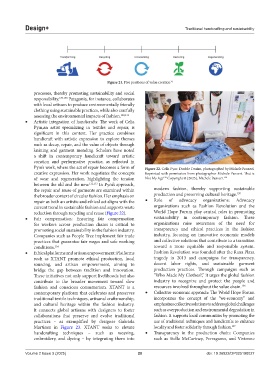
               Pym’s work, where the act of repair becomes a form of   Figure 22. Celia Pym: Double Denim, photographed by Michele Panzeri.
               creative expression. Her work negotiates the concepts   Reprinted with permission from photographer Michele Panzeri. That is
               of wear and regeneration, highlighting the tension   Not My Age  Copyright © [2025], Michele Panzeri. 133
                                                                       133
               between the old and the new. 132,133  In Pym’s approach,
               the repair and reuse of garments are examined within   modern fashion, thereby supporting sustainable
               the broader context of circular fashion. Her emphasis on   production and preserving cultural heritage. 135
               repair as both an artistic and ethical act aligns with the   •   Role  of  advocacy  organizations:  Advocacy
               current trend in sustainable fashion and supports waste   organizations such as  Fashion  Revolution and  the
               reduction through recycling and reuse (Figure 22).  World Hope Forum play central roles in promoting
            •   Fair compensation: Ensuring fair compensation     sustainability  in contemporary  fashion.  These
               for workers across production chains is critical to   organizations raise  awareness of  the  need  for
               promoting social sustainability in the fashion industry.   transparency and  ethical  practices in  the  fashion
               Companies such as People Tree implement fair trade   industry, focusing on innovative economic models
               practices that guarantee fair wages and safe working   and collective solutions that contribute to a transition
               conditions. 134                                    toward a more equitable and responsible system.
            •   Ethical platforms and artisan empowerment: Platforms   Fashion Revolution was founded after the Rana Plaza
               such as XTANT promote ethical production, local    tragedy in 2013 and campaigns for transparency,
               sourcing, and artisan empowerment, aiming to       decent labor rights, and sustainable garment
               bridge the gap between tradition and innovation.   production practices. Through campaigns such as
               These initiatives not only support livelihoods but also   “Who Made My Clothes?,” it urges the global fashion
               contribute to the broader movement toward slow     industry to recognize and protect the people and
               fashion and conscious consumerism. XTANT is a      resources involved throughout the value chain. 136
               contemporary platform that celebrates and preserves   •   Collective economic approach: The World Hope Forum
               traditional textile techniques, artisanal craftsmanship,   incorporates  the  concept  of  the “we-economy”  and
               and cultural heritage within the fashion industry.   emphasizes collective solutions to address global challenges
               It connects global artisans with designers to foster   such as overproduction and environmental degradation in
               collaborations that preserve and evolve traditional   fashion. It supports local communities by promoting the
               practices – as exemplified by designer Gabriela    use of traditional techniques and handicrafts to enhance
               Martinez in  Figure  23. XTANT seeks to elevate    locality and foster solidarity through fashion. 137
               handcrafting techniques – such as weaving,      •   Transparency in the production chain: Companies
               embroidery, and dyeing – by integrating them into   such as Stella McCartney, Ferragamo, and Vivienne


            Volume 2 Issue 3 (2025)                         20                           doi: 10.36922/DP025190027

