


Page 24 - DP-2-3
P. 24
Design+                                                             Traditional handcrafting and sustainability


                         A                          B


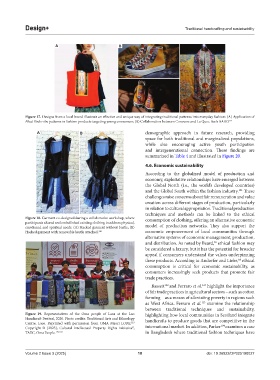
            Figure 17. Designs from a local brand illustrate an effective and unique way of integrating traditional patterns into everyday fashion: (A) Application of
            Nhat Binh robe patterns in fashion products targeting young consumers; (B) Collaboration between Converse and La Quoc Bao’s BARO 117
                 A                 B                           demographic approach in future research, providing
                                                               space for both traditional and marginalized populations,
                                                               while  also  encouraging  active  youth  participation
                                                               and intergenerational connection. These findings are
                                                               summarized in Table 4 and illustrated in Figure 20.
                                                               4.6. Economic sustainability
                                                               According  to  the  globalized  model  of  production  and
                                                               economy, exploitative relationships have emerged between
                                                               the Global North (i.e., the world’s developed countries)
                                                               and the Global South within the fashion industry.  These
                                                                                                       121
                                                               challenges raise concerns about fair remuneration and value
                                                               creation across different stages of production, particularly
                                                               in relation to cultural appropriation. Traditional production
                                                               techniques and methods can be linked to the ethical
            Figure 18. Garment co-designed during a collaborative workshop, where   consumption of clothing, offering an alternative economic
            participants altered and embellished existing clothing to address physical,
            emotional, and spiritual needs. (A) Hacked garment without bustle; (B)   model of production networks. They also support the
            Hacked garment with removable bustle attached. 118  economic empowerment of local communities through
                                                               alternative systems of economic management, production,
                                                               and distribution. As noted by Beard,  ethical fashion may
                                                                                            55
                                                               be considered a luxury, but it has the potential for broader
                                                               appeal if consumers understand the values underpinning
                                                               these products. According to Andorfer and Liebe,  ethical
                                                                                                      68
                                                               consumption is critical for economic sustainability, as
                                                               consumers increasingly seek products that promote fair
                                                               trade practices.
                                                                 Bassett and Ferraro et al.  highlight the importance
                                                                                       123
                                                                       122
                                                               of fair trade practices in agricultural sectors – such as cotton
                                                               farming – as a means of alleviating poverty in regions such
                                                               as West Africa. Ferraro et al.  examine the relationship
                                                                                       123
                                                               between traditional techniques and sustainability,
            Figure  19. Representatives of the Oma people of Laos at the Lao   highlighting how local communities in Scotland integrate
            Handicraft Festival, 2020. Photo credits: Traditional Arts and Ethnology   handicrafts to produce goods that are competitive in the
                                                         119
            Centre, Laos. Reprinted with permission from OMA Māori LORE.                       104
            Copyright © [2025], Cultural Intellectual Property Rights Initiative®,   international market. In addition, Parker examines a case
            TAEC, Oma People. 119,120                          in Bangladesh where traditional fashion techniques have


            Volume 2 Issue 3 (2025)                         18                           doi: 10.36922/DP025190027

