


Page 27 - EER-1-1
P. 27
Explora: Environment
            and Resource                                                        WTW emissions of road and rail transport


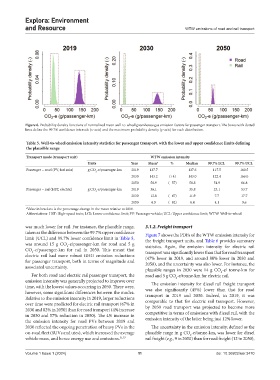
            Figure 6. Probability density functions of normalized mean well-to-wheel greenhouse gas emission factors for passenger transport. The boxes with dotted
            lines define the 99.7% confidence intervals (x-axis) and the maximum probability density (y-axis) for each distribution.

            Table 5. Well‑to‑wheel emission intensity statistics for passenger transport, with the lower and upper confidence limits defining
            the plausible range
            Transport mode (transport unit)                      WTW emission intensity
                                      Units              Year   Mean a    %     Median   99.7% LCL   99.7% UCL
            Passenger – road (PV, fuel mix)  g CO -e/passenger-km  2019  137.7   137.6      117.5      160.5
                                          2
                                                         2030    143.2   (+4)    143.0      122.4      166.0
                                                         2050    58.9    (−57)    58.8      51.9        66.8
            Passenger – rail (HST, electric)  g CO -e/passenger-km  2019  36.1    35.8      23.1        53.7
                                          2
                                                         2030    12.0    (−67)    11.9      7.7         17.7
                                                         2050    6.5     (−82)    6.4       4.1         9.6
            a Value in brackets is the percentage change in the mean relative to 2019.
            Abbreviations: HST: High-speed train; LCL: Lower confidence limit; PV: Passenger vehicle; UCL: Upper confidence limit; WTW: Well-to-wheel.

            was much lower for rail. For instance, the plausible range,   3.1.2. Freight transport
            taken as the difference between the 99.7% upper confidence   Figure 7 shows the PDFs of the WTW emission intensity for
            limit (UCL) and 99.7% lower confidence limit in Table 5,   the freight transport units, and Table 6 provides summary
            was  around  15  g  CO -e/passenger-km  for  road  and  5  g   statistics. Again, the emission intensity for electric rail
                             2
            CO -e/passenger-km for rail in 2050. This meant that   transport was significantly lower than that for road transport
               2
            electric rail had more robust GHG emission reductions   (47% lower in 2019, and around 80% lower in 2030 and
            for passenger transport, both in terms of magnitude and   2050), and the uncertainty was also lower. For instance, the
            associated uncertainty.
                                                               plausible ranges in 2030 were 14  g CO -e/  tonne-km for
                                                                                               2
              For both road and electric rail passenger transport, the   road and 5 g CO -e/tonne-km for electric rail.
            emission intensity was generally projected to improve over      2
                                                                 The emission intensity for diesel rail freight transport
            time, with the lowest values occurring in 2050. There were,   was also significantly (45%) lower than that for road
            however, some significant differences between the modes.   transport  in  2019  and  2030.  Indeed,  in  2019,  it  was
            Relative to the emission intensity in 2019, larger reductions
            over time were predicted for electric rail transport (67% in   comparable to that for electric rail transport. However,
            2030 and 82% in 2050) than for road transport (4% increase   by  2050 road  transport was  projected  to  become more
                                                               competitive in terms of emissions with diesel rail, with the
            in 2030 and 57% reduction in 2050). The 4% increase in
            the emission intensity for road PVs between 2019 and   emission intensity of the latter being just 12% lower.
            2030 reflected the ongoing penetration of heavy PVs in the   The uncertainty in the emission intensity, defined as the
            on-road fleet (SUVs and utes), which increased the average   plausible range in g CO -e/tonne-km, was lower for diesel
                                                                                  2
            vehicle mass, and hence energy use and emissions. 31,37  rail freight (e.g., 9 in 2050) than for road freight (12 in 2050),

            Volume 1 Issue 1 (2024)                         11                               doi: 10.36922/eer.3470

