


Page 24 - EER-1-1
P. 24
Explora: Environment
            and Resource                                                        WTW emissions of road and rail transport


            capacity (seats) and occupancy, and how these related to
            the stated energy consumption values, were not provided,
            increasing the uncertainty in the results. The variability
            in energy consumption will also have been influenced by
            other factors, including speed, stop frequency, and line
            gradient. For the purpose of this study, it was assumed that
            the overall distribution of energy consumption would be
            broadly representative of HST implementation in Australia.
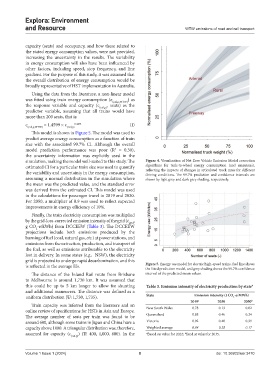
              Using the data from the literature, a non-linear model
            was fitted using train energy consumption (e (rail,p,WTW) ) as
            the response variable and capacity (c (rail,p) , seats) as the
            predictor variable, assuming that all trains would have
            more than 200 seats, that is:
            e       = 1.4599 × c  0.4271                (I)
             (rail,p,WTW)    (rail,p)
              This model is shown in Figure 5. The model was used to
            predict average energy consumption as a function of train
            size with the associated 99.7% CI. Although the overall
            model  prediction  performance  was  poor  (R   =  0.30),
                                                  2
            the uncertainty information was explicitly used in the
            simulation, making the model well-suited to this study. The   Figure 4. Visualization of Net Zero Vehicle Emission Model correction
            estimated CI for a particular train size was used to quantify   algorithms for tank-to-wheel energy consumption (and emissions),
            the variability and uncertainty in the energy consumption,   reflecting the impacts of changes in articulated truck mass for different
                                                               driving conditions. The 99.7% prediction and confidence intervals are
            assuming a normal distribution in the simulation where   shown by light grey and dark grey shading, respectively.
            the mean was the predicted value, and the standard error
            was derived from the estimated CI. This model was used
            in the calculations for passenger travel in 2019 and 2030.
            For 2050, a multiplier of 0.9 was used to reflect expected
            improvements in energy efficiency of 10%.
              Finally, the train electricity consumption was multiplied
            by the grid-loss-corrected emission intensity of the grid (ε ,
                                                        grid
            g CO -e/kWh) from DCCEEW (Table 3). The DCCEEW
                2
            projections include both emissions produced by the
            burning of fuel (coal, natural gas, etc.) at power stations, and
            emissions from the extraction, production, and transport of
            the fuel, as well as emissions attributable to the electricity
            lost in delivery. In some states (e.g.,  NSW), the electricity
            grid is projected to undergo rapid decarbonization, and this
            is reflected in the average EIs.                   Figure 5. Energy use model for electric high-speed trains. Red line shows
                                                               the fitted prediction model, and grey shading shows the 99.7% confidence
              The distance of the Inland Rail route from Brisbane   interval of the predicted mean values.
            to Melbourne is around 1,730  km. It was assumed that
            this could be up to 5  km longer to allow for shunting   Table 3. Emission intensity of electricity production by state 4
            and additional maneuvers. The distance was defined as a
            uniform distribution (U: 1,730, 1,735).            State                Emission intensity (t CO ‑e/MWh)
                                                                                                    2
                                                                                  2019 a      2030       2050 b
              Train capacity was inferred from the literature and an
            online review of specifications for HSTs in Asia and Europe.   New South Wales  0.78  0.13   0.02
            The average number of seats per train was found to be   Queensland     0.88       0.46       0.24
            around 600, although some trains in Japan and China have a   Victoria  0.92       0.40       0.39
            capacity above 1000. A triangular distribution was, therefore,   Weighted average  0.84  0.28  0.17
            assumed for capacity (c (rail,p) ) (T: 400, 1,000, 600). In the   a Based on value for 2022;  fixed at value for 2035.
                                                                                b


            Volume 1 Issue 1 (2024)                         8                                doi: 10.36922/eer.3470

