


Page 21 - EER-1-1
P. 21
Explora: Environment
            and Resource                                                        WTW emissions of road and rail transport


            Table 1. Definition of reference transport units
            Mode            Transport unit                                Definition
            Passenger transport
             Road  PV (passenger vehicle, fuel/energy mix)  Average Australian passenger vehicle, based on a travel weighted (VKT)  combination of small/
                                                                                             a
                                               medium/large cars and compact/large SUVs reflecting a mix of powertrains: ICEV (petrol,
                                               diesel, liquefied petroleum gas), HEV, PHEV, BEV, and FCEV.
             Rail  PT   (passenger train, electric)  Hypothetical average electric high-speed train based on a review of the international literature.
                     electric
            Freight transport
             Road  (AT, fuel/energy mix)       Heavy-duty vehicle (B-double associated with long-haul transport) with a gross vehicle mass
                                               of 90 tonnes and an average payload of 33 tonnes that reflected a travel-weighted (VKT) mix of
                                               powertrains (ICEV, HEV, PHEV, BEV, and FCEV).
             Rail7  FT  (freight train, diesel)  Typical diesel container train for the Inland Rail route, consisting of three National Rail class
                     diesel
                                               locomotives and wagons with 40% double stacking. The train had a nominal length of 1,800 m in 2030
                                               and 3,600 m in 2050, with corresponding mean unladen weights of 1,750 tonnes and 2,700 tonnes.
                   FT   (freight train, electric)  As diesel train, but with reduced energy consumption for electric drive.
                     electric
            Abbreviations: AT: Articulated truck; BEV: Battery electric vehicle; FCEV: Fuel-cell electric vehicle; FT: Freight train; HEV: Hybrid electric vehicle;
            ICEV: Internal combustion engine vehicle; PHEV: Plug-in hybrid electric vehicle; PT: Passenger train; PV: Passenger vehicle; SUV: Sport-utility vehicle;
            VKT: Vehicle-km travelled.


                                  Figure 3. Flow diagram showing the approach followed in the probabilistic analysis

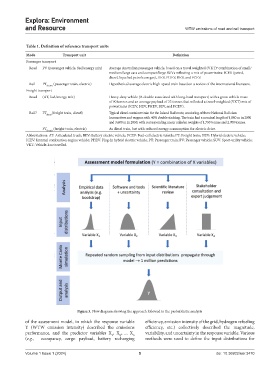
            of the assessment model, in which the response variable   efficiency, emission intensity of the grid, hydrogen refueling
            Y (WTW emission intensity) described the emissions   efficiency, etc.) collectively described the magnitude,
            performance,  and  the  predictor  variables  X ,  X ,…,  X    variability, and uncertainty in the response variable. Various
                                                    2
                                                 1
                                                          n
            (e.g.,   occupancy,  cargo  payload,  battery  recharging   methods were used to define the input distributions for
            Volume 1 Issue 1 (2024)                         5                                doi: 10.36922/eer.3470

