


Page 23 - EER-1-1
P. 23
Explora: Environment
            and Resource                                                        WTW emissions of road and rail transport


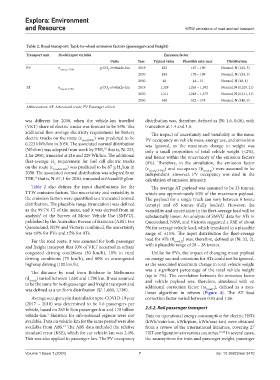
            Table 2. Road transport: Tank‑to‑wheel emission factors (passengers and freight)
            Transport unit  Model input variable                       Emission factor
                                                Units       Year  Typical value  Plausible min‑max  Distribution
            PV            e  (road, p, TTW)  g CO -e/vehicle-km  2019  182        167 – 196    Normal, N (182, 5)
                                               2
                                                            2030      184         170 – 199    Normal, N (184, 5)
                                                            2050      48           44 – 51     Normal, N (48, 1)
            AT            e                 g CO -e/vehicle-km  2019  1,329      1,265 – 1,392  Normal, N (1,329, 21)
                            (road, f, TTW)     2
                                                            2030     1,311       1,248 – 1,373  Normal, N (1,311, 21)
                                                            2050      548         522 – 574    Normal, N (548, 9)
            Abbreviations: AT: Articulated truck; PV: Passenger vehicle.

            was different for 2050, when the vehicle-km travelled   distribution was, therefore, defined as (N: 1.6, 0.06), with
            (VKT) share of electric trucks was forecast to be 55%. The   truncation at 1.4 and 1.8.
            additional fleet-average electricity requirement for battery   The impact of uncertainty and variability in the mean
            electric trucks on the route (e (road,BEV) ) was predicted to be   PV occupancy on vehicle mass, energy use, and emissions
            0.223 kWh/km in 2050. The associated normal distribution   was  ignored,  as  the  maximum  change  in weight  was
            (Wh/km) was adopted from work by TER,  that is, N: 223,   only a small proportion of total vehicle weight (<2%),
                                             16
            2 for 2050, truncated at 216 and 229 Wh/km. The additional   and hence within the uncertainty of the emission factors
            fleet-average  H   requirement  for  fuel  cell  electric  trucks   (8%). Therefore, in the simulation, the emission factor
                        2
            on the route (c (road,FCEV) ) was predicted to be 67 g H /km in   (e  ) and occupancy (φ  ) were assumed to be
                                                    2
                                                                                       (road,p)
                                                                (road,p,TTW)
            2050. The associated normal distribution was adopted from   independent. However, PV occupancy was used in the
            TER,  that is, N: 67, 1 for 2050, truncated at 65 and 69 g/km.  calculation of emission intensity.
                16
              Table 2 also defines the input distributions for the   The average AT payload was assumed to be 33 tonnes,
            TTW emission factors. The uncertainty and variability in   which was approximately 50% of the maximum payload.
            the emission factors were quantified as a truncated normal   The payload for a single truck can vary between 0 tonne
            distribution. The plausible range (truncation) was defined   (empty) and 65 tonnes  (fully loaded). However, the
            as the 99.7% CI of the mean, and it was derived from an   variability and uncertainty in the fleet-average load will be
            analysis  of the Survey of Motor Vehicle Use (SMVU),   substantially lower. An analysis of SMVU data for ATs in
                  8
            published by the Australian Bureau of Statistics (ABS). For   Queensland, NSW, and Victoria suggested a RSE of about
            Queensland, NSW and Victoria combined, the uncertainty   5% for average vehicle load, which translated to a plausible
            was ±8% for PVs and ±5% for ATs.                   range  of  ±15%.  The  input  distribution  for  fleet-average
              For the road route, it was assumed for both passenger   load for ATs (θ (road,f) ) was, therefore, defined as (N: 33, 2),
            and freight transport that 10% of VKT occurred in urban/  with a plausible range of 28 – 38 tonnes.
            congested driving conditions (30  km/h), 10% in rural   Unlike for PVs, the impact of changing mean payload
            driving conditions (75  km/h), and 80% in uncongested   on energy use and emissions for ATs could not be ignored,
            highway driving (100 km/h).                        as the associated maximum change in total vehicle weight
                                                               was a significant percentage of the total vehicle weight
              The distance by road from Brisbane to Melbourne
            (d (road) ) varied between 1,660 and 1,780 km. It was assumed   (up to 7%). The correlation between the emission factor
                                                               and vehicle payload was, therefore, simulated with an
            to be the same for both passenger and freight transport and   additional correction factor (ω  ), defined as a non-
            was defined as a uniform distribution (U: 1,660, 1,780).                     (road,f)
                                                               linear algorithm in n0vem (Figure  4). The AT load
              Average occupancy in Australia for a pre-COVID-19 year   correction factor varied between 0.95 and 1.06.
            (2017  –  2018)  was  determined  to  be  1.6  passengers  per
            vehicle, based on 283 billion passenger-km and 178 billion   2.5.2. Rail passenger transport
                     3
            vehicle-km.  Statistics for sub-national regions were not   Data on operational energy consumption for electric HSTs
            available. Data on vehicle-km for the same period were also   (kWh/train-km, kWh/pkm, kWh/seat-km) were obtained
            available from ABS.  The ABS data included the relative   from a review of the international literature, covering 27
                            17
            standard error (RSE), which for car vehicle-km was 2.4%.   HST configurations in various countries. 18-28  In several cases,
            This was also applied to passenger-km. The PV occupancy   the assumptions for train and passenger weight, passenger


            Volume 1 Issue 1 (2024)                         7                                doi: 10.36922/eer.3470

