


Page 28 - EER-1-1
P. 28
Explora: Environment
            and Resource                                                        WTW emissions of road and rail transport


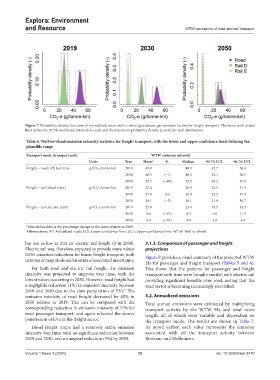
            Figure 7. Probability density functions of normalized mean well-to-wheel greenhouse gas emission factors for freight transport. The boxes with dotted
            lines define the 99.7% confidence intervals (x-axis) and the maximum probability density (y-axis) for each distribution.

            Table 6. Well‑to‑wheel emission intensity statistics for freight transport, with the lower and upper confidence limit defining the
            plausible range

            Transport mode (transport unit)                      WTW emission intensity
                                       Units          Year    Mean a   %       Median    99.7% LCL  99.7% UCL
            Freight – road (AT, fuel mix)  g CO -e/tonne-km  2019  49.0         48.9       42.7        56.6
                                          2
                                                      2030     48.3    (−1)     48.2       42.1        56.1
                                                      2050     29.5    (−40)    29.5       24.2        35.8
            Freight – rail (diesel train)  g CO -e/tonne-km  2019  27.0         26.9       22.5        31.9
                                          2
                                                      2030     27.0    (0)      26.9       22.5        31.9
                                                      2050     26.1    (−3)     26.1       21.8        30.7
            Freight – rail (electric train)  g CO -e/tonne-km  2019  25.8       25.6       19.5        33.7
                                          2
                                                      2030     8.6     (−67)    8.5        6.6         11.3
                                                      2050     5.0     (−81)    4.9        3.8         6.4
            a Value in brackets is the percentage change in the mean relative to 2019.
            Abbreviations: AT: Articulated truck; LCL: Lower confidence limit; UCL: Upper confidence limit; WTW: Well-to-wheel.

            but not as low as that for electric rail freight (3 in 2050).   3.1.3. Comparison of passenger and freight
            Electric rail was, therefore, expected to provide more robust   projections
            GHG emission reductions for future freight transport, both   Figure 8 provides a visual summary of the projected WTW
            in terms of magnitude and in terms of associated uncertainty.
                                                               EIs for passenger and freight transport (Tables 5 and 6).
              For both road and electric rail freight, the emission   This shows that the patterns for passenger and freight
            intensity was projected to improve over time, with the   transport with time were broadly similar, with electric rail
            lowest values occurring in 2050. However, road freight had   providing significant benefits over road, noting that the
            a negligible reduction (1%) in emission intensity between   road sector is becoming increasingly electrified.
            2019 and 2030 due to the slow penetration of EVs.  The
                                                      5
            emission intensity of road freight decreased by 40% in   3.2. Annualized emissions
            2050 relative to 2019. This can be compared with the   Total annual emissions were estimated by multiplying
            corresponding reduction in emission intensity of 57% for   transport activity by the WTW EIs and total route
            road passenger transport, and again reflected the slower   length, all of which were variable and dependent on
            penetration of EVs in the freight sector.          the transport mode. The results are shown in Table 7.
              Diesel freight trains had a relatively stable emission   As noted earlier, each value represents the emission
            intensity over time, with no significant reduction between   associated with all the transport activity between
            2019 and 2030, and a marginal reduction (3%) by 2050.  Brisbane and Melbourne.


            Volume 1 Issue 1 (2024)                         12                               doi: 10.36922/eer.3470

