


Page 20 - EER-1-1
P. 20
Explora: Environment
            and Resource                                                        WTW emissions of road and rail transport


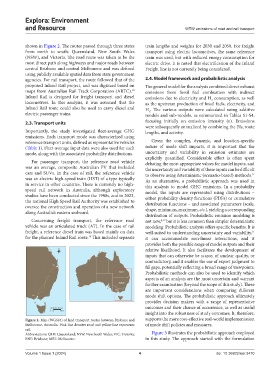
            shown in Figure 2. The routes passed through three states   train lengths and weights for 2030 and 2050. For freight
            from north to south: Queensland, New South Wales   transport using electric locomotives, the same reference
            (NSW), and Victoria. The road route was taken to be the   train was used, but with reduced energy consumption for
            most direct path along highways and major roads between   electric drive. It is noted that electrification of the Inland
            central Brisbane and central Melbourne and was defined   Freight line is not currently being considered.
            using publicly available spatial data from state government
            agencies. For rail transport, the route followed that of the   2.4. Model framework and probabilistic analysis
            proposed Inland Rail project, and was digitized based on   The general model for the analysis combined direct exhaust
            maps from Australian Rail Track Corporation (ARTC).    emissions from fossil fuel combustion with indirect
                                                         10
            Inland Rail is designed for freight transport and diesel   emissions due to electricity and H  consumption, as well
                                                                                           2
            locomotives. In this analysis, it was assumed that the   as the upstream production of fossil fuels, electricity, and
            Inland Rail route could also be used to carry diesel and   H . The various outputs were calculated using additive
                                                                2
            electric passenger trains.                         models and sub-models, as summarized in Tables S1-S4,
            2.3. Transport units                               focusing initially on emission intensity (ε). Emissions
                                                               were subsequently annualized by combining the EIs, route
            Importantly, the study investigated fleet-average GHG   lengths, and activity.
            emissions. Each transport mode was characterized using
            reference transport units, defined as representative vehicles   Given the complex, dynamic, and location-specific
            (Table 1). Fleet-average input data were also used for each   nature of mode shift impacts, it is important that the
            mode, along with the associated probability distributions.  uncertainty and variability in emission estimates are
                                                               explicitly  quantified. Considerable effort is  often spent
              For passenger transport, the reference road vehicle   debating the most appropriate values for model inputs, and
            was an average, composite Australian PV that included   the uncertainty and variability of these inputs can be difficult
            cars and SUVs. In the case of rail, the reference vehicle   to observe using deterministic (scenario-based) methods.
                                                                                                            11
            was an electric high-speed train (HST) of a type typically   As an alternative, a probabilistic approach was used in
            in service in other countries. There is currently no high-  this analysis to model GHG emissions. In a probability
            speed rail network in Australia, although exploratory   model, the inputs are represented using distributions –
            studies have been conducted since the 1980s, and in 2023,   either probability density functions (PDFs) or cumulative
            the national High Speed Rail Authority was established to   distribution functions – and associated parameters (scale,
            oversee the construction and operation of a new network   shape, minimum, maximum, etc.), yielding a corresponding
            along Australia’s eastern seaboard.
                                                               distribution of outputs. Probabilistic emission modeling is
              Concerning freight transport, the reference road   not new,  but it is less common than simpler deterministic
                                                                     8,12
            vehicle was an articulated truck (AT). In the case of rail   modeling. Probabilistic analysis offers specific benefits. It is
            freight, a reference diesel train was based mainly on data   well-suited to understanding uncertainty and variability,
                                                                                                            11
            for the planned Inland Rail route.  This included separate   it can accommodate non-linear interactions, and it
                                       10
                                                               provides both the possible range of model outputs and their
                                                               relative likelihood. It also facilitates the development of
                                                               inputs that can otherwise be scarce, of unclear quality, or
                                                               contradictory, and it enables the use of expert judgment to
                                                               fill gaps, potentially reflecting a broad range of viewpoints.
                                                               Probabilistic methods can also be used to identify which
                                                               aspects of an analysis are the most uncertain and warrant
                                                               further examination (beyond the scope of this study). These
                                                               are  important  considerations  when  comparing  different
                                                               mode shift options. The probabilistic approach ultimately
                                                               provides decision makers with a range of representative
                                                               outcomes and their chance of occurrence, as well as useful
                                                               insight into the robustness of study outcomes. It, therefore,
            Figure 2. Map (WGS84) of land transport routes between Brisbane and   supports the more cost-effective real-world implementation
            Melbourne, Australia. Pink line denotes road and yellow line represents   of mode shift policies and measures.
            rail.
            Abbreviations: QLD: Queensland; NSW: New South Wales; VIC: Victoria;   Figure 3 illustrates the probabilistic approach employed
            BNE: Brisbane; MEL: Melbourne.                     in this study. The approach started with the formulation


            Volume 1 Issue 1 (2024)                         4                                doi: 10.36922/eer.3470

