


Page 130 - EER-2-1
P. 130
Explora: Environment
            and Resource                                                   Sustainable fertilization for long bean cultivation


            soil properties. The increase in soil pH from 5.2 to 5.8 is
            particularly noteworthy, as it suggests a reduction in soil
            acidity, which is critical for improving nutrient availability
            and  reducing  toxicity  from  aluminum  ions.  The  organic
            matter content doubled from 1.25% to 2.50%, reflecting
            the contribution of quail manure in enriching the soil with
            organic carbon and enhancing its physical properties. 10,13
              The available phosphorus concentration increased
            from 8.3 to 18.7  mg/kg, demonstrating the synergistic
            effect of organic manure and natural phosphate. Organic
            manure enhances microbial activity, which facilitates
            phosphorus solubilization from natural phosphate, thereby
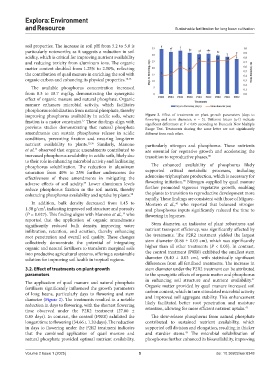
            improving  phosphorus  availability in  acidic  soils, where   Figure  2.  Effect of treatments on plant growth parameters (days to
            fixation is a major constraint.  These findings align with   flowering and stem diameter;  n = 3). Different letters (a-f) indicate
                                    17
                                                               significant differences at P < 0.05 according to Duncan’s New Multiple
            previous studies demonstrating that natural phosphate   Range Test. Treatments sharing the same letter are not significantly
            amendments  can  sustain  phosphorus  release  in  acidic   different from each other.
            conditions,  preventing  fixation  and  ensuring  long-term
            nutrient availability to plants. 35,36  Similarly, Manono   particularly  nitrogen  and  phosphorus.  These  nutrients
            et al.  observed that organic amendments contributed to   are essential for vegetative growth and accelerating the
                14
            increased phosphorus availability in acidic soils, likely due   transition to reproductive phases. 30
            to their role in enhancing microbial activity and facilitating
            phosphorus  solubilization.  The  reduction  in  aluminum   The enhanced availability of phosphorus likely
            saturation from 40% to 25% further underscores the   supported critical metabolic processes, including
            effectiveness of  these  amendments  in  mitigating  the   adenosine triphosphate production, which is necessary for
                                                                               39
            adverse effects of soil acidity.  Lower aluminum levels   flowering initiation.  Nitrogen supplied by quail manure
                                     37
            reduce phosphorus fixation in the soil matrix, thereby   further  promoted  vigorous  vegetative  growth,  enabling
            enhancing phosphorus availability and uptake by plants. 38  the plants to transition to reproductive development more
                                                               rapidly. These findings are consistent with those of Míguez-
              In addition, bulk density decreased from 1.45 to   Montero  et al.,  who reported that balanced nitrogen
                                                                            40
            1.30 g/cm³, indicating improved soil structure and porosity   and phosphorus inputs significantly reduced the time to
            (P = 0.027). This finding aligns with Manono et al.,  who   flowering in legumes.
                                                     14
            reported that the application of organic amendments
            significantly reduced bulk density, improving water   Stem diameter, an indicator of plant robustness and
            infiltration, retention, and aeration, thereby enhancing   nutrient transport efficiency, was significantly affected by
            root penetration and overall soil quality. These changes   the treatments. The P2R2 treatment yielded the largest
            collectively demonstrate the potential of integrating   stem diameter (0.86 ± 0.03 cm), which was significantly
            organic and natural fertilizers to transform marginal soils   higher than all other treatments (P < 0.05). In contrast,
            into productive agricultural systems, offering a sustainable   the control treatment (P0R0) exhibited the smallest stem
            solution for improving soil health in tropical regions.  diameter (0.40 ± 0.03  cm), with statistically significant
                                                               differences from all fertilized treatments. The increase in
            3.2. Effect of treatments on plant growth          stem diameter under the P2R2 treatment can be attributed
            parameters                                         to the synergistic effects of organic matter and phosphorus
            The application of quail manure and natural phosphate   in enhancing soil structure and nutrient availability. 41
            fertilizers significantly influenced the growth parameters   Organic matter provided by quail manure increased soil
            of  long beans, particularly days  to  flowering  and  stem   carbon content, which in turn stimulated microbial activity
            diameter (Figure 2). The treatments resulted in a notable   and improved soil aggregate stability. This enhancement
            reduction in days to flowering, with the shortest flowering   likely facilitated better root penetration and moisture
                                                                                                         42
            time observed under the P2R2 treatment (27.00 ±    retention, allowing for more efficient nutrient uptake.
            0.85 days). In contrast, the control (P0R0) exhibited the   The slow-release phosphorus from natural phosphate
            longest time to flowering (34.66 ± 1.20 days). The reduction   contributed  to  sustained  nutrient  availability,  which
            in days to flowering under the P2R2 treatment indicates   supported cell division and elongation, resulting in thicker
            that the combined application of quail manure and   and sturdier stems.  The microbial solubilization of
                                                                                43
            natural phosphate provided optimal nutrient availability,   phosphorus further enhanced its bioavailability, improving

            Volume 2 Issue 1 (2025)                         5                                doi: 10.36922/eer.8348

