


Page 131 - EER-2-1
P. 131
Explora: Environment
            and Resource                                                   Sustainable fertilization for long bean cultivation


            root elongation and branching, which facilitated greater   (96.66 cm) observed under the P2R2 treatment (3 kg quail
            nutrient uptake. 17,20  In addition, the increased nitrogen   manure per plot and 25 g natural phosphate per plant).
            mineralization from quail manure decomposition provided   In contrast, the control treatment (P0R0) produced the
            a steady supply of essential nitrogen, which is crucial for   shortest pods (60.66 cm). The enhanced pod length under
            chlorophyll synthesis and overall vegetative growth. 33,44  the P2R2 treatment can be attributed to improved nutrient

              These findings align with previous research by De Prato   availability, particularly phosphorus, which is essential for
                                                                                              45
            et al.,  who reported similar improvements in stem diameter   cell elongation and pod development.  The slow-release
                43
            in hemp crops when organic amendments were integrated   nature of phosphorus in natural phosphate ensured a
            with phosphorus-based fertilizers. Furthermore, the   consistent supply of this critical nutrient throughout the pod
            reduction in aluminum saturation (40% to 25%) observed   growth phase. These results align with findings by Rahaman
                                                                    30
            in the soil analysis likely contributed to an improved   et al.,  who demonstrated that phosphorus availability
            root environment, minimizing toxicity and enhancing   significantly increased pod elongation in legumes.
            nutrient  absorption  efficiency.  The  effectiveness  of  the   The number of pods per plant also increased
            P2R2 treatment in improving plant growth parameters on   significantly with the treatments. The P2R2 treatment
            podzolic soils highlights its potential as a sustainable soil   produced the highest number of pods (36.66/plant), while
            amendment strategy. The integration of quail manure and   the control recorded the lowest (12.00/plant). This increase
            natural phosphate not only enhanced nutrient availability   reflects the improved soil fertility and nutrient availability
            but also improved soil physical properties, creating a more   provided by the combined amendments, which supported
            conducive environment for root development and nutrient   robust reproductive growth.  Organic matter supplied by
                                                                                     46
            transport. The consistent superiority of the P2R2 treatment   quail manure likely enhanced soil structure and microbial
            across all measured growth parameters suggests that a   activity, facilitating efficient nutrient uptake.  These
                                                                                                      13
            balanced combination of organic matter and slow-release   findings are consistent with those of Fekadu et al.,  who
                                                                                                        46
            phosphorus is essential for optimizing plant development   reported significant increases in pod production of faba
            in acidic, nutrient-deficient soils.               bean with organic amendments.
            3.3. Effect on yield components                      Pod weight per plant was the most significantly
            The yield components of long beans, including pod length,   impacted yield parameter, with the P2R2 treatment
            number  of  pods  per  plant,  and  pod  weight  per  plant,   producing the highest weight (2850.66 g/plant) compared
            exhibited  significant  improvements  with  the  application   to the control (802.33 g/plant). This substantial increase
            of  quail  manure  and  natural  phosphate  fertilizers.   highlights the effectiveness of integrating quail manure
            The combination of these amendments consistently   and natural phosphate fertilizers in enhancing nutrient
            outperformed the control treatment across all measured   availability, improving soil structure, and optimizing
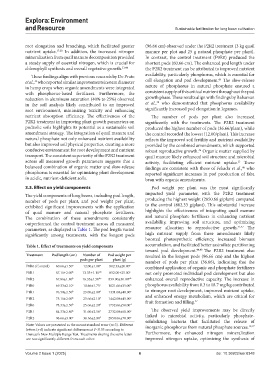
            parameters, as displayed in Table 1. The pod length varied   resource allocation to reproductive growth. 41,47  The
            significantly among treatments, with the longest pods   high nutrient supply from these amendments likely
                                                               boosted photosynthetic efficiency, increased biomass
            Table 1. Effect of treatments on yield components  accumulation, and facilitated better assimilate partitioning
                                                               toward pod development. 44,48  The P2R2 treatment also
            Treatment  Pod length (cm)  Number of   Pod weight per   resulted in the longest pods (96.66  cm) and the highest
                                   pods per plant  plant (g)   number of pods per plant (36.66), indicating that the
            P0R0 (Control)  60.66±1.50 a  12.00±1.00 a  802.33±20.00 a  combined application of organic and phosphate fertilizers
            P0R1         67.16±2.00 b  13.33±1.10 a,b  852.00±25.00 a  not only promoted individual pod development but also
            P0R2         67.66±1.80 b  16.33±1.50 b,c  859.00±30.00 a,b  enhanced  overall  reproductive capacity.  The  increase  in
            P1R0         69.33±2.10 a  18.66±1.75 c  1021.66±35.00 b  phosphorus availability from 8.3 to 18.7 mg/kg contributed
            P1R1         76.50±2.50 b  23.00±2.00 d  1331.00±40.00 c  to stronger root development, improved nutrient uptake,
            P1R2         75.16±2.00 b  23.66±2.10 d  1442.00±45.00 c  and enhanced energy metabolism, which are critical for
                                                               fruit formation and filling.
                                                                                    47
            P2R0         78.33±2.50 b  25.66±2.20 d  1732.66±50.00 d
            P2R1         84.33±2.80 b  31.00±2.50 e  2732.00±60.00 e  The observed yield improvements may be directly
            P2R2         96.66±3.00 c  36.66±2.80 f  2850.66±70.00 e  linked to microbial activity, particularly phosphate-
                                                               solubilizing bacteria that facilitated the release of
            Note: Values are presented as the mean±standard error (n=3). Different   inorganic phosphorus from natural phosphate sources. 10,17
            letters (a-f) indicate significant differences at P<0.05 according to
            Duncan’s New Multiple Range Test. Treatments sharing the same letter   Furthermore, the enhanced nitrogen mineralization
            are not significantly different from each other.   improved nitrogen uptake, optimizing the synthesis of


            Volume 2 Issue 1 (2025)                         6                                doi: 10.36922/eer.8348

