


Page 132 - EER-2-1
P. 132
Explora: Environment
            and Resource                                                   Sustainable fertilization for long bean cultivation


            amino acids and proteins, which are essential for pod filling   fertilization strategy not only enhances nutrient availability
            and biomass accumulation.  In addition, the reduction   but also improves soil physical properties, leading to more
                                  49
            in aluminum saturation (40% – 25%) created a more   sustainable crop production. These results are particularly
            favorable rhizosphere environment, mitigating potential   relevant for tropical regions with inherently low soil
            root stress and supporting optimal nutrient absorption.   fertility, where conventional chemical fertilizers may not be
                                                     47
            These  findings  align  with  those  of  Islam  et al.,   who   a long-term solution due to economic and environmental
            reported significant improvements in pod weight when   constraints.
            organic and phosphate fertilizers were applied in tropical   The  effectiveness  of  integrating  organic  amendments
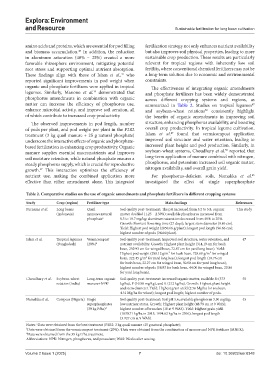
            legumes. Similarly, Manono  et al.  demonstrated that   and phosphate fertilizers has been widely demonstrated
                                         14
            phosphorus  amendments  in  combination  with  organic   across different cropping systems and regions, as
            matter can increase the efficiency of phosphorus use,   summarized  in  Table  2.  Studies  on  tropical  legumes
                                                                                                            47
            enhance microbial activity, and improve soil aeration, all   and soybean-wheat rotations  consistently highlight
                                                                                        50
            of which contribute to increased crop productivity.  the benefits of organic amendments in improving soil
              The observed improvements in pod length, number   structure, enhancing phosphorus availability, and boosting
            of pods per plant, and pod weight per plant in the P2R2   overall crop productivity. In tropical legume cultivation,
                                                                          47
            treatment (3 kg quail manure + 25 g natural phosphate)   Islam  et al.   found  that  vermicompost  application
            underscore the interactive effects of organic and phosphate-  improved soil structure and water retention, leading to
            based fertilization in enhancing crop productivity. Organic   increased plant height and pod production. Similarly, in
                                                                                                 50
            manure supplies essential macronutrients and improves   soybean-wheat systems, Choudhary et al.  reported that
            soil moisture retention, while natural phosphate ensures a   long-term application of manure combined with nitrogen,
            steady phosphorus supply, which is crucial for reproductive   phosphorus, and potassium increased soil organic matter,
            growth.  This interaction optimizes the efficiency of   nitrogen availability, and overall grain yield.
                  47
            nutrient use, making the combined application more   For  phosphorus-deficient  soils,  Namakka  et  al.
                                                                                                            45
            effective than either amendment alone. This integrated   investigated the effect of single superphosphate

            Table 2. Comparative studies on the use of organic amendments and phosphate fertilizers in different cropping systems
            Study        Crop (region)  Fertilizer type                Main findings                 References
            Purnama et al.  Long beans   Quail      Soil quality post-treatment: The pH increased from 5.2 to 5.8; organic   This study
                         (Indonesia)  manure+natural   matter doubled (1.25 – 2.50%); available phosphorus increased from
                                      phosphate a   8.3 to 18.7 mg/kg; aluminum saturation decreased from 40% to 25%.
                                                    Growth: Shortest flowering time (27 days); largest stem diameter (0.86 cm).
                                                    Yield: Highest pod weight (2850.66 g/plant); longest pod length (96.66 cm);
                                                    highest number of pods (36.66/plant).
            Islam et al.  Tropical legumes   Vermicompost   Soil quality post-treatment: Improved soil structure, water retention, and   47
                         (Bangladesh)  (20%) b      nutrient availability. Growth: Highest plant height (314.19 cm for bush
                                                    bean, 259.93 cm for winged bean, 72.87 cm for yard long bean). Yield:
                                                    Highest pod weight (298.12 g/m² for bush bean, 728.69 g/m² for winged
                                                    bean, 222.45 g/m² for yard long bean); longest pod length (10.76 cm
                                                    for bush bean, 22.27 cm for winged bean, 30.00 cm for yard long bean);
                                                    highest number of pods (58.93 for bush bean, 44.00 for winged bean, 20.86
                                                    for yard long bean).
            Choudhary et al.  Soybean-wheat   Long-term organic   Soil quality post-treatment: Increased organic matter, available N (373   50
                         rotation (India)  manure+NPK c  kg/ha), P (10.58 mg/kg), and K (212 kg/ha). Growth: Highest plant height
                                                    and stem diameter. Yield: Highest grain yield (2.56 Mg/ha for soybean,
                                                    4.31 Mg/ha for wheat); longest pod length; highest number of pods.
            Namakka et al.  Cowpeas (Nigeria) Single   Soil quality post-treatment: Soil pH 5.6; available phosphorus 3.50 mg/kg;   45
                                      superphosphates    low nutrient status. Growth: Highest plant height (48.79 cm at 9 WAS);
                                      (39 kg P/ha) d  highest number of branches (18 at 9 WAS). Yield: Highest grain yield
                                                    (1830.71 kg/ha in 2015, 1994.62 kg/ha in 2016); longest pod length
                                                    (3.927 cm at 9 WAS).
            Notes:  Data were obtained from the best treatment (P2R2: 3 kg quail manure+25 g natural phosphate);
                 a
            b Data were obtained from the vermicompost treatment (20%);  Data were obtained from the combination of manure and NPK fertilizer (MNPK);
                                                    c
            d Data were obtained from the 39 kg P/ha treatment.
            Abbreviations: NPK: Nitrogen, phosphorus, and potassium; WAS: Weeks after sowing.
            Volume 2 Issue 1 (2025)                         7                                doi: 10.36922/eer.8348

