


Page 50 - EER-2-1
P. 50
Explora: Environment
            and Resource                                                         Statistical analysis of climate time series


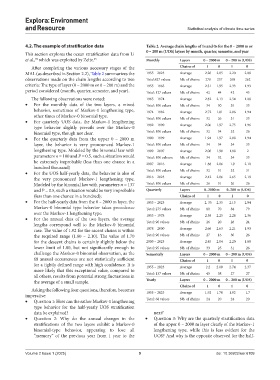
            4.2. The example of stratification data            Table 2. Average chain lengths of 1s and 0s for the 0 – 2000 m or
                                                               0 – 200 m (UOS) layers by month, quarter, semester, and year
            This section explores the ocean stratification data from Li
            et al.,  which was exploited by Zeltz. 25          Monthly        Layers    0 – 2000 m  0 – 200 m (UOS)
                32
              After completing the various necessary stages of the            Chains of  1    0    1      0
            MAL (as described in Section 2.2), Table 2 summarizes the   1955 – 2023  Average  2.20  2.05  2.20  2.08
            observations made on the chain lengths according to two   Total:827 values  Nb. of chains   270  257  268  262
            criteria: The type of layer (0 – 2000 m or 0 – 200 m) and the   1955 – 1965  Average  2.31  1.95  2.33  1.93
            period considered (month, quarter, semester, and year).  Total: 127 values  Nb. of chains  42  44  42  45
              The following observations were noted:           1965 – 1974    Average   2.82  2.13  2.54  1.88
            •   For the monthly data of the two layers, a mixed   Total: 100 values  Nb. of chains  34  30  35  33
               behavior, sometimes of Markov-1 lengthening type,   1974 – 1982  Average  2.72  1.81  2.06  1.94
               other times of Markov-0 binomial type.          Total: 100 values  Nb. of chains  32  26  31  33
            •   For  quarterly  UOS  data, the Markov-1  lengthening
               type behavior slightly prevails over the Markov-0   1982 – 1990  Average  2.06  1.97  2.75  1.96
               binomial type, though not clear.                Total: 100 values  Nb. of chains  32  34  32  26
            •   For  the  quarterly data from the upper  0  –  2000  m   1990 – 1999  Average  1.94  1.97  2.08  1.94
               layer, the behavior is very pronounced Markov-1   Total: 100 values  Nb. of chains  34  34  34  33
               lengthening type. Modeled by the binomial law with   1999 – 2007  Average  2.00  1.90  1.88  2
               parameters n = 100 and P = 0.5, such a situation would   Total: 100 valeurs  Nb. of chains  34  32  34  33
               be extremely improbable (less than one chance in a   2007 – 2016  Average  1.88  2.06  1.9  2.10
               hundred thousand)
            •   For the UOS half-yearly data, the behavior is also of   Total: 100 values  Nb. of chains  32  31  32  31
               the very pronounced Markov-1 lengthening type.   2016 – 2023   Average   2.42  2.06  2.65  2.19
               Modeled by the binomial law with parameters n = 137   Total: 100 values  Nb. of chains  26  31  26  26
               and P = 0.5, such a situation would be very improbable   Quarterly  Layers  0–2000 m  0–200 m (UOS)
               (less than one chance in a hundred);                           Chains of   1    0    1      0
            •   For the half-yearly data from the 0 – 2000 m layer, the   1955 – 2023  Average  2. 35  2.35  2.13  2.04
               Markov-0 binomial type behavior takes precedence   Total: 275 values  Nb. of chains  80  70  84  79
               over the Markov-1 lengthening type.             1955 – 1978    Average   2.38  2.25  2.28  2.36
            •   For the annual data of the two layers, the average   Total: 90 values  Nb. of chains  26  20  26  24
               lengths correspond well to the Markov-0 binomial
               case. The value of 1.92 for the ascent chains is within   1978 – 2000  Average  2.66  2.63  2.21  1.93
               the required range (1.80 – 2.10). The value of 1.70   Total: 90 values  Nb. of chains  27  16  30  26
               for the descent chains is certainly slightly below the   2000 – 2023  Average  2.45  2.04  2.20  1.89
               lower limit of 1.80, but not significantly enough to   Total: 95 values  Nb. of chains  33  25  31  26
               challenge the Markov-0 binomial observation, as the   Semesterly  Layers  0 – 2000 m  0 – 200 m (UOS)
               68 annual occurrences are not statistically sufficient         Chains of  1    0    1      0
               for a tightly defined range with high confidence. It is   1955 – 2023  Average  2.2  2.00  2.74  2.37
               more likely that this exceptional value, compared to
               all others, results from potential strong fluctuations in   Total: 137 values  Nb. of chains  45  38  27  27
               the average of a small sample.                  Yearly         Layers    0 – 2000 m  0 – 200 m (UOS)
                                                                              Chains of  1    0    1      0
              Asking the following four questions, therefore, becomes   1955 – 2023  Average  1.92  1.70  1.92  1.7
            imperative:
            •   Question 1: How can the rather Markov-1 lengthening   Total: 68 values  Nb. of chains  24  20  24  20
               type behavior for the half-yearly UOS stratification
               data be explained?                                 next?
            •   Question 2: Why do the annual changes in the   •   Question 3: Why are the quarterly stratification data
               stratifications  of  the  two  layers  exhibit  a  Markov-0   of the upper 0 – 2000 m layer clearly of the Markov-1
               binomial-type behavior, appearing to lose all      lengthening type, while this is less evident for the
               “memory”  of  the  previous  year  from  1  year  to  the   UOS? And why is the opposite observed for the half-


            Volume 2 Issue 1 (2025)                         9                                doi: 10.36922/eer.6109

