


Page 63 - EER-2-1
P. 63
Explora: Environment
            and Resource                                                                Sustainable urban park design


            efforts were made to ensure that participants had a high   experience. Regarding income levels, the participants were
            level of education. Approximately 57% of the participants   approximately equally distributed. In terms of professions,
            were university graduates, and 29% held a master’s or   the leading groups were educators (academics, teachers,
            doctoral degree. The participants were predominantly   and students), architects, and engineers.
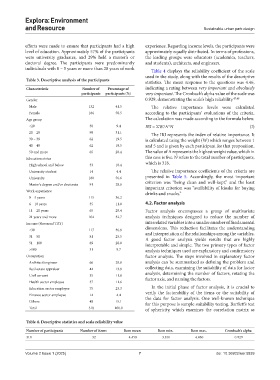
            individuals with 0 – 5 years or more than 20 years of work   Table 4 displays the reliability coefficient of the scale

                                                               used in the study, along with the results of the descriptive
            Table 3. Descriptive analysis of the participants  statistics. The mean response to the questions was 4.46,
            Characteristic          Number of   Percentage of   indicating a rating between very important and absolutely
                                    participants  participants (%)  very important. The Cronbach’s alpha value of the scale was
            Gender                                             0.929, demonstrating the scale’s high reliability. 47,48
             Male                      132        41.5           The relative importance levels were calculated
             Female                    186        58.5         according to the participants’ evaluations of the criteria.
            Age group                                          The calculation was made according to the formula below.
             <20                       30          9.4         IRI = ΣW/A*N                                (I)
             20 – 29                   99         31.1           The IRI represents the index of relative importance. It
             30 – 39                   62         19.5         is calculated using the weight (W) which ranges between 1
             40 – 49                   62         19.5         and 5 and is given by each participant for that proposition.
             50 and more               65         20.4         The value of A represents the highest weight value, which in
            Education status                                   this case is five. N refers to the total number of participants,
             High school and below     33         10.4         which is 318.
             University student        14          4.4           The relative importance coefficients of the criteria are
             University                180        56.6         presented in  Table 5. Accordingly, the most important
             Master’s degree and/or doctorate  91  28.6        criterion was “being clean and well-kept,” and the least
            Work experience                                    important criterion was “availability of kiosks for buying
                                                               drinks and snacks.”
             0 – 5 years               115        36.2
             6 – 10 years              35         11.0         4.2. Factor analysis
             11 – 20 years             65         20.4         Factor analysis encompasses a group of multivariate
             21 years and more         104        32.7         analysis techniques designed to reduce the number of
            Income (thousand TRY)                              interrelated variables into a smaller number of fundamental
             <30                       117        36.8         dimensions. This reduction facilitates the understanding
             31 – 50                   81         25.5         and interpretation of the relationships among the variables.
                                                               A  good factor analysis yields results that are highly
             51 – 100                  89         28.0         interpretable and simple. The two primary types of factor
             >100                      31          9.7         analysis techniques used are explanatory and confirmatory
            Occupation                                         factor analysis. The steps involved in explanatory factor
             Architect/engineer        66         20.8         analysis can be summarized as defining the problem and
             Real estate appraiser     44         13.8         collecting data, examining the suitability of data for factor
             Civil servant             35         11.0         analysis, determining the number of factors, rotating the
                                                               factor axis, and naming the factors.
             Health sector employee    37         11.6
             Education sector employee  75        23.3           In the initial phase of factor analysis, it is crucial to
             Finance sector employee   14          4.4         verify the factorability of the items or the suitability of
                                                               the data for factor analysis. One well-known technique
             Others                    48         15.1
                                                               for this purpose is sample suitability testing. Bartlett’s test
             Total                     318        100.0        of sphericity, which examines the correlation matrix as

            Table 4. Descriptive statistics and scale reliability value
            Number of participants  Number of items   Item mean     Item min.     Item max.      Cronbach’s alpha
            318                         32              4.458         3.810         4.860            0.929


            Volume 2 Issue 1 (2025)                         7                                doi: 10.36922/eer.5839

