


Page 64 - EER-2-1
P. 64
Explora: Environment
            and Resource                                                                Sustainable urban park design


            Table 5. Relative importance indexes of design elements  Table 6. Kaiser–Meyer–Olkin and Bartlett’s test results
            No.a              Design element           IRI     Kaiser–Meyer–Olkin measure of sampling adequacy  0.904
            9     Being clean and well-kept           0.972    Bartlett’s test of sphericity  Approximate Chi-square  4,847.146
            10    Safe to be used at all hours        0.950                        Degrees of freedom    496
            8     Suitable for use by the physically disabled  0.949               Significance value   0.000
            6     Suitable for childrens use          0.945
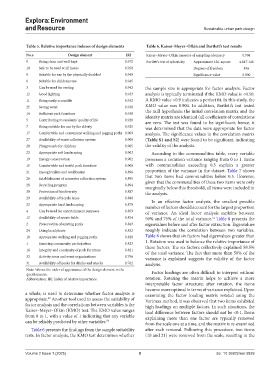
            3     Can be used for resting             0.942    the sample size is appropriate for factor analysis. Factor
            12    Good lighting                       0.933    analysis is typically terminated if the KMO value is <0.50.
            11    Being easily accessible             0.932    A KMO value >0.9 indicates a perfect fit. In this study, the
            25    Saving water                        0.930    KMO value was 0.904. In addition, Bartlett’s test tested
            14    Sufficient park furniture           0.930    the null hypothesis: the initial correlation matrix and the
                                                               identity matrix are identical (all coefficients of correlations
            5     Contributing to residents’ quality of life  0.928  are zero. The test was found to be significant; hence, it
            7     Being suitable for use by the elderly  0.925  was determined that the data were appropriate for factor
            17    Comfortable and convenient walking and jogging paths 0.909  analysis. The significance values in the correlation matrix
            27    Availability of waste collection system  0.908  (Table S1 and S2) were found to be significant, indicating
            20    Playgrounds for children            0.905    the validity of the analysis.
            22    Appropriate soft landscaping        0.903      According  to the  communalities  table, every variable
            19    Energy conservation                 0.902    possesses a common variance ranging from 0 to 1. Items
            15    Comfortable and useful park furniture  0.900  with communalities exceeding 0.5 explain a greater
            21    Enough toilets and washbasins       0.896    proportion of the variance in the dataset. Table 7 shows
            26    Establishment of rainwater collection system  0.895  that two items had communalities below 0.5. However,
                                                               given that the communalities of these two items were only
            28    Recycling program                   0.894    marginally below this threshold, all items were included in
            30    Protection of biodiversity          0.887    the analysis.
            29    Availability of bicycle lanes       0.880
                                                                 In an effective factor analysis, the smallest possible
            23    Appropriate hard landscaping        0.879    number of factors should account for the largest proportion
            4     Can be used for entertainment purposes  0.859  of variance. An ideal factor analysis explains between
            13    Availability of sports fields       0.854    50% and 75% of the total variance.  Table 8 presents the
                                                                                           51
            2     Preservation of existing parks      0.843    eigenvalues before and after factor extraction. Eigenvalues
            24    Using local plants                  0.832    roughly indicate the correlation between two variables.
            18    Appropriate walking and jogging paths  0.828  Table 8 shows that six factors had eigenvalues greater than
            1     Ensuring community participation    0.823    1. Rotation was used to balance the relative importance of
            16    Integrity and continuity of park furniture  0.821  these factors. The six factors collectively explained 58.5%
                                                               of the total variance. The fact that more than 50% of the
            32    Activity areas and event organizations  0.796  variance is explained suggests the validity of the factor
            31    Availability of kiosks for drinks and snacks  0.762  analysis.
            Note:  shows the order of appearance of the design element in the   Factor loadings are often difficult to interpret without
                a
            questionnaire.
            Abbreviation: IRI: Index of relative importance.   rotation. Rotating the matrix helps to achieve a more
                                                               interpretable factor structure; after rotation, the items
                                                               become more optimal in terms of variance explained. Upon
            a whole, is used to determine whether factor analysis is   examining the factor loading matrix rotated using the
            appropriate.  Another tool used to assess the suitability of   Varimax method, it was observed that two items exhibited
                     49
            factor analysis and the correlations between variables is the   high loadings on multiple factors. In such situations, the
            Kaiser–Meyer–Olkin (KMO) test. The KMO value ranges   load difference between factors should not be <0.1. Items
            from 0 to 1, with a value of 1 indicating that any variable   explaining more than one factor are typically removed
            can be reliably predicted by other variables. 50   from the scale one at a time, and the matrix is re-examined
              Table 6 presents the findings from the sample suitability   after each removal. Following this procedure, two items
            tests. In factor analysis, the KMO test determines whether   (10 and 21) were removed from the scale, resulting in the


            Volume 2 Issue 1 (2025)                         8                                doi: 10.36922/eer.5839

