


Page 65 - EER-2-2
P. 65
Explora: Environment
            and Resource                                                           Application of Algae for seed priming


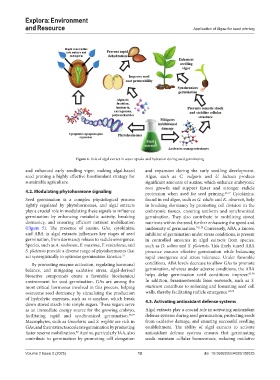
                                 Figure 4. Role of algal extract in water uptake and hydration during seed germinating
            and enhanced early  seedling vigor, making algal-based   and expansion during the early seedling development.
            seed priming a highly effective biostimulant strategy for   Algae, such as  C. vulgaris and  U. lactuca produce
            sustainable agriculture.                           significant amounts of auxins, which enhance embryonic
                                                               root growth and support faster and stronger radicle
            4.2. Modulating phytohormone signaling             protrusion when used for seed priming. 21,77  Cytokinins,
            Seed germination is a complex physiological process   found in red algae, such as G. edulis and K. alvarezii, help
            tightly regulated by  phytohormones,  and algal extracts   in breaking dormancy by promoting cell division in the
            play a crucial role in modulating these signals to influence   embryonic tissues, ensuring uniform and synchronized
            germination by enhancing metabolic activity, breaking   germination. They also contribute to mobilizing stored
            dormancy, and ensuring efficient nutrient mobilization   nutrients within the seed, further enhancing the speed and
            (Figure  5). The presence of auxins, GAs, cytokinins,   uniformity of germination. 74,120  Conversely, ABA, a known
            and ABA in algal extracts influences  key stages  of  seed   inhibitor of germination under stress conditions, is present
            germination, from dormancy release to radicle emergence.   in  controlled  amounts  in  algal  extracts  from  species,
            Species, such as A. nodosum, E. maxima, F. vesiculosus, and   such as D. salina and S. platensis. This finely tuned ABA
            S. platensis provide a diverse range of phytohormones that   presence  ensures  effective  germination  while  balancing
            act synergistically to optimize germination kinetics. 77  rapid  emergence and  stress  tolerance.  Under  favorable

              By promoting enzyme activation, regulating hormonal   conditions, ABA levels decrease to allow GAs to promote
            balance,  and  mitigating  oxidative  stress,  algal-derived   germination, whereas under adverse conditions, the ABA
            bioactive compounds create a favorable biochemical   helps delay germination until conditions improve. 82,76
            environment  for  seed  germination.  GAs  are  among  the   In  addition,  brassinosteroids  from  seaweeds,  such  as  S.
            most critical hormones involved in this process, helping   muticum contribute to softening and loosening seed cell
            overcome seed dormancy by stimulating the production   walls, thereby facilitating radicle emergence. 22,78
            of hydrolytic enzymes, such as  α-amylase, which break   4.3. Activating antioxidant defense systems
            down stored starch into simple sugars. These sugars serve
            as an immediate energy source for the growing embryo,   Algal extracts play a crucial role in activating antioxidant
            facilitating rapid and synchronized germination. 76,77    defense systems during seed germination, protecting seeds
            Macrophytes, such as Gracilaria and S. wightii are rich in   from oxidative damage, and ensuring successful seedling
            GAs, and their extracts accelerate germination by promoting   establishment. The ability of algal extracts to activate
            faster reserve mobilization.  Auxins, particularly IAA, also   antioxidant defense systems ensures that germinating
                                 82
            contribute to germination by promoting cell elongation   seeds maintain cellular homeostasis, reducing oxidative

            Volume 2 Issue 2 (2025)                         12                          doi: 10.36922/EER025120025

