


Page 62 - EER-2-2
P. 62
Explora: Environment
            and Resource                                                           Application of Algae for seed priming


            contains 0.2 – 1.0 µg/g dry weight of these powerful growth   components of seaweed; they are powerful bioactive
            enhancers. 22,78,79                                compounds that enhance plant growth and fortify
                                                               seeds  against  environmental  stress  when  used  in  seed
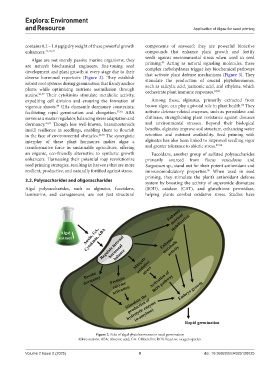
              Algae are not merely passive marine organisms; they     83
            are nature’s biochemical engineers, fine-tuning seed   priming.  Acting as natural signaling molecules, these
            development and plant growth at every stage due to their   complex carbohydrates trigger key biochemical pathways
                                                               that activate plant defense mechanisms (Figure  3). They
            diverse hormonal repertoire (Figure  2). They establish   stimulate the production of crucial phytohormones,
            robust root systems during germination that firmly anchor   such as salicylic acid, jasmonic acid, and ethylene, which
            plants  while  optimizing  nutrient  assimilation  through   orchestrate plant immune responses. 84,85
            auxins. 21,77  Their cytokinins stimulate metabolic activity,
            expediting cell division and ensuring the formation of   Among these, alginates, primarily extracted from
                                                                                                        86
            vigorous shoots.  GAs dismantle dormancy constraints,   brown algae, can play a pivotal role in plant health.  They
                         80
            facilitating rapid germination and elongation. 77,81  ABA   activate defense-related enzymes, such as peroxidase and
            serves as a master regulator, balancing stress adaptation and   chitinase, strengthening plant resistance against diseases
            dormancy. 76,82   Though  less  well-known,  brassinosteroids   and environmental stresses. Beyond their biological
            instill resilience in seedlings, enabling them to flourish   benefits, alginates improve soil structure, enhancing water
            in the face of environmental obstacles. 22,78  The synergistic   retention and nutrient availability. Seed priming with
            interplay of these plant hormones makes algae a    alginates has also been linked to improved seedling vigor
            transformative force in sustainable agriculture, offering   and greater tolerance to abiotic stress. 87-89
            an organic, eco-friendly alternative to synthetic growth   Fucoidans, another group of sulfated polysaccharides
            enhancers.  Harnessing  their  potential  may  revolutionize   primarily  sourced  from  Fucus  vesiculosus  and
            seed priming strategies, resulting in harvests that are more   Sargassum sp., stand out for their potent antioxidant and
            resilient, productive, and naturally fortified against stress.  immunomodulatory  properties.   When used in  seed
                                                                                         90
                                                               priming, they  stimulate the plant’s  antioxidant  defense
            3.2. Polysaccharides and oligosaccharides          system by boosting the activity of superoxide dismutase
            Algal polysaccharides, such as alginates, fucoidans,   (SOD), catalase (CAT), and glutathione peroxidase,
            laminarins, and carrageenans, are not just structural   helping plants combat oxidative stress. Studies have


                                          Figure 2. Role of algal phytohormones in seed germination
                                  Abbreviations: ABA: Abscisic acid; GA: Gibberellin; ROS: Reactive oxygen species.


            Volume 2 Issue 2 (2025)                         9                           doi: 10.36922/EER025120025

