


Page 60 - EER-2-2
P. 60
Explora: Environment
            and Resource                                                           Application of Algae for seed priming


            Table 1. (Continued)
            No.    Name of algae    Class     Seed species   Concentration         Effect            References
                                               applied
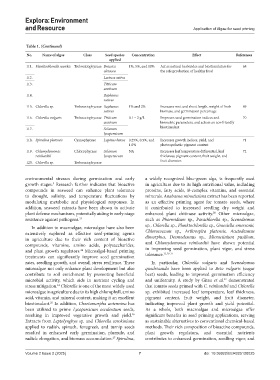
            111. Planktochlorella nurekis Trebouxiophyceae Brassica   1%, 5%, and 10%  Act as natural herbicides and biostimulators for   68
                                             oleracea                the safe production of healthy food
            112.                             Lactuca sativa
            113.                             Triticum
                                             aestivum
            114.                             Raphanus
                                             sativus
            115. Chlorella sp.   Trebouxiophyceae Raphanus   1% and 2%  Increases root and shoot length, weight of fresh   69
                                             sativus                 biomass, and germination percentage
            116. Chlorella vulgaris  Trebouxiophyceae Triticum   0.1 – 2 g/L  Improves seed germination indices and   70
                                             aestivum                biometric parameters, and acts as an eco-friendly
            117.                             Solanum                 biostimulant
                                             lycopersicum
            118. Spirulina platensis  Cyanophyceae  Lupinus luteus 0.25%, 0.5%, and   Increases growth indices, yield, and   71
                                                        1.0%         photosynthetic pigment content
            119. Chlamydomonas   Chlorophyceae  Solanum   NA         Increases leaf temperature differential, leaf   72
                reinhardtii                  lycopersicum            thickness, pigment content, fruit weight, and
            120. Chlorella sp.   Trebouxiophyceae                    fruit diameter.


            environmental stresses during germination and early   a widely recognized blue-green alga, is frequently used
            growth stages.  Research further  indicates  that bioactive   in agriculture due to its high nutritional value, including
                       5
            compounds in seaweed can enhance plant tolerance   proteins,  fatty  acids,  B-complex  vitamins,  and essential
            to drought, salinity, and temperature fluctuations by   minerals. Anabaena minutissima extract has been reported
            modulating  metabolic  and  physiological  responses.  In   as an effective priming agent for tomato seeds, where
            addition,  seaweed  extracts  have  been  shown  to  activate   it contributed to increased seedling dry weight and
            plant defense mechanisms, potentially aiding in early-stage   enhanced plant chitinase activity.  Other microalgae,
                                                                                            28
            resistance against pathogens. 23                   such  as  Phormidium  sp.,  Parachlorella  sp.,  Scenedesmus
              In addition to macroalgae, microalgae have also been   sp., Chlorella sp., Planktochlorella sp., Graesiella emersonii,
            extensively explored as effective seed-priming agents   Chlorococcum  sp., Arthrospira platensis, Acutodesmus
            in agriculture due to their rich content of bioactive   dimorphus, Desmodesmus  sp., Micractinium pusillum,
            compounds,  vitamins,  amino acids,  polysaccharides,   and  Chlamydomonas reinhardtii have shown potential
            and plant growth regulators.  Microalgal-based priming   in  improving  seed  germination,  plant  vigor,  and  stress
                                   24
                                                                       23,29-31
            treatments can significantly improve seed germination   tolerance.
            rates, seedling growth, and overall stress resilience. These   In  particular,  Chlorella vulgaris  and  Scenedesmus
            microalgae not only enhance plant development but also   quadricauda have been applied to  Beta  vulgaris (sugar
            contribute to soil enrichment by  promoting  beneficial   beet) seeds, leading to improved germination efficiency
            microbial  activity,  which  aids  in  nutrient  cycling  and   and  uniformity.  A  study  by  Gitau  et al.   demonstrated
                                                                                                32
            stress mitigation.  Chlorella is one of the most widely used   that tomato seeds primed with C. reinhardtii and Chlorella
                         12
            microalgae in agriculture due to its high chlorophyll, amino   sp. exhibited increased leaf temperature, leaf thickness,
            acid, vitamin, and mineral content, making it an excellent   pigment content, fruit weight, and fruit diameter,
            biostimulant.  In addition, Chaetomorpha antennina has   indicating improved plant growth and yield potential.
                      25
            been utilized to prime  Lycopersicum  esculentum seeds,   As a whole, both macroalgae and microalgae offer
            resulting in improved vegetative growth and yield.    significant benefits in seed priming applications, serving
                                                         26
            Extracts from Leptolyngbya sp. and Chlorella sorokiniana   as sustainable alternatives to conventional chemical-based
            applied to radish, spinach, fenugreek, and turnip seeds   methods. Their rich composition of bioactive compounds,
            resulted in enhanced early germination, plumule, and   plant growth regulators, and essential nutrients
            radicle elongation, and biomass accumulation.  Spirulina,   contributes to enhanced germination, seedling vigor, and
                                                 27

            Volume 2 Issue 2 (2025)                         7                           doi: 10.36922/EER025120025

