


Page 61 - EER-2-2
P. 61
Explora: Environment
            and Resource                                                           Application of Algae for seed priming


            environmental stress resilience. As research continues to   acid (IAA), are the master regulators of root development.
            advance, optimizing algal-based priming techniques holds   They fuel cell elongation, stimulate lateral root formation,
            promise for improving crop productivity and supporting   and optimize nutrient uptake. Certain algae stand  out
            sustainable agricultural practices.                as rich auxin reservoirs: A. nodosum (0.1 – 5.5 µg/g dry
                                                               weight),  C. vulgaris (up to 2.5  µg/mL in extract), and
            3. Bioactive components in algal extracts          U. lactuca (0.6 – 3.1 µg/g dry weight). 21,22
            relevant to seed priming                             Cytokinins, on the other hand, act as the architects of

            Seed germination is a highly coordinated process initiated   growth – igniting cell division, mobilizing nutrients, and
            by mitochondrial repair and respiration activation,   delaying leaf senescence. Their role in seed germination
            followed by mRNA translation and protein synthesis.   and shoot elongation makes them indispensable. Potent
            Energy metabolism and DNA repair facilitate cell cycle   algal sources of cytokinins include  A. nodosum  (0.05
            activation, while hormone biosynthesis and deactivation   – 2.8  µg/g dry weight),  G. edulis (0.4 – 1.9  µg/g), and
            regulate key developmental transitions. As germination   Spirulina platensis (0.3 – 1.5 µg/g). 74,75
            progresses, mitochondrial synthesis and embryo growth   When it comes to seed dormancy and shoot elongation,
            accelerate, accompanied by endosperm weakening and   GA takes center stage. They break dormancy barriers,
            testa rupture. The regulation of oxidative status and   accelerate seed germination, and activate enzymes crucial
            efficient mobilization of stored reserves sustain metabolic   for early seedling growth. Laminaria digitata holds up to
            activity, fueling cell division, DNA synthesis, and radical   1.2  µg/g dry weight,  Sargassum wightii ranges between
            cell elongation. Starch biosynthesis and aerobic respiration   0.5 and 1.6 µg/g dry weight, while Chlorella pyrenoidosa
            further contribute to seedling establishment and   provides 0.8 – 1.4 µg/g dry weight. 76,77
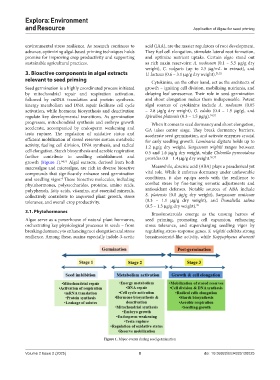
            growth (Figure  1). 64,73  Algal extracts, derived from both
            macroalgae and microalgae, are rich in diverse bioactive   Meanwhile, abscisic acid (ABA) plays a paradoxical yet
            compounds that significantly enhance seed germination   vital role. While it enforces dormancy under unfavorable
            and seedling vigor.  These bioactive molecules, including   conditions, it also equips seeds with the resilience to
                           4
            phytohormones, polysaccharides, proteins, amino acids,   combat stress by fine-tuning osmotic adjustments and
            polyphenols, fatty acids, vitamins, and essential minerals,   antioxidant defenses. Notable sources of ABA include
            collectively contribute to improved plant growth, stress   S. platensis  (0.8  µg/g  dry  weight),  Sargassum muticum
            tolerance, and overall crop productivity.          (0.3 – 1.1  µg/g dry weight), and  Dunaliella salina
                                                               (0.5 – 1.3 µg/g dry weight). 76
            3.1. Phytohormones                                   Brassinosteroids emerge as  the  unsung  heroes  of

            Algae serve as a powerhouse of natural plant hormones,   seed priming, promoting cell expansion, enhancing
            orchestrating key physiological processes in seeds – from   stress  tolerance,  and supercharging seedling  vigor  by
            breaking dormancy to enhancing root elongation and stress   regulating stress-response genes. S. wightii exhibits strong
            resilience. Among these, auxins especially indole-3-acetic   brassinosteroid-like activity, while  Kappaphycus alvarezii


                                             Figure 1. Major events during seed germination


            Volume 2 Issue 2 (2025)                         8                           doi: 10.36922/EER025120025

