


Page 116 - EER-2-3
P. 116
Explora: Environment
            and Resource                                                                     Enzymatic degradation


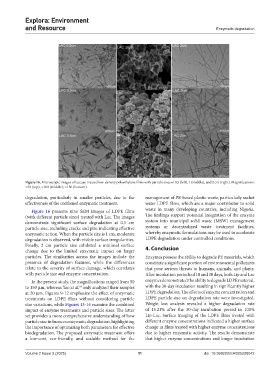
            Figure 16. Microscopic images of laccase-treated low-density polyethylene films with particle sizes of 0.5 (left), 1 (middle), and 2 cm (right). Magnifications:
            ×50 (top); ×100 (middle); ×150 (bottom).

            degradation, particularly in smaller particles, due to the   management of PE-based plastic waste, particularly sachet
            effectiveness of the combined enzymatic treatment.  water LDPE films, which are a major contributor to solid
              Figure  16 presents nine SEM images of LDPE films   waste in many developing countries, including Nigeria.
            (with different particle sizes) treated with Lac. The images   The findings support potential integration of the enzyme
            demonstrate significant surface degradation at 0.5  cm   system into municipal solid waste (MSW) management
            particle size, including cracks and pits, indicating effective   systems or decentralized waste treatment facilities,
            enzymatic action. When the particle size is 1 cm, moderate   whereby enzymatic formulations may be used to accelerate
            degradation is observed, with visible surface irregularities.   LDPE degradation under controlled conditions.
            Finally, 2  cm particle size exhibited a minimal surface   4. Conclusion
            change due to the limited enzymatic impact on larger
            particles. The similarities across the images include the   Enzymes possess the ability to degrade PE materials, which
            presence of degradation features, while the differences   constitute a significant portion of environmental pollutants
            relate to the severity of surface damage, which correlates   that pose serious threats to humans, animals, and plants.
            with particle size and enzyme concentration.       After incubation periods of 10 and 30 days, both Lip and Lac
              In the present study, the magnifications ranged from 50   enzymes demonstrated the ability to degrade LDPE material,
            to 150 µm, whereas Yao et al.  only analyzed their samples   with the 30-day incubation resulting in significantly higher
                                   59
            at 20 µm. Figures 9-12 emphasize the effect of enzymatic   LDPE degradation. The effects of enzyme concentration and
            treatments on LDPE films without considering particle   LDPE particle size on degradation rate were investigated.
            size variations, while Figures 13-16 examine the combined   Weight loss analysis revealed a higher degradation rate
            impact of enzyme treatments and particle sizes. The latter   of 15.21% after the 30-day incubation period in 100%
            set provides a more comprehensive understanding of how   Lip-Lac. Surface imaging of the LDPE films treated with
            particle size influences enzymatic degradation, highlighting   different enzyme concentrations indicated a higher surface
            the importance of optimizing both parameters for effective   change in films treated with higher enzyme concentrations
            biodegradation. The proposed enzymatic treatment offers   due to higher enzymatic activity. The results demonstrate
            a  low-cost,  eco-friendly,  and  scalable  method  for  the   that higher enzyme concentrations and longer incubation


            Volume 2 Issue 3 (2025)                         11                          doi: 10.36922/EER025220042

