


Page 111 - EER-2-3
P. 111
Explora: Environment
            and Resource                                                                     Enzymatic degradation


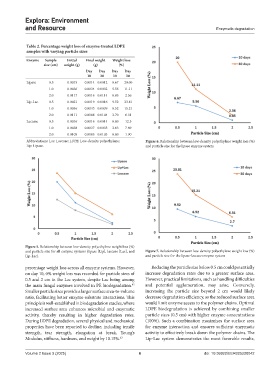
            Table 2. Percentage weight loss of enzyme‑treated LDPE
            samples with varying particle sizes
            Enzyme  Sample    Initial   Final weight   Weight loss
                    size (cm)  weight (g)  (g)     (%)
                                      Day   Day   Day   Day
                                      10    30   10    30
            Lipase    0.5     0.0015  0.0014 0.0012  6.67  20.00
                      1.0     0.0036  0.0034 0.0032  5.56  11.11
                      2.0     0.0117  0.0116 0.0114  0.85  2.56
            Lip-Lac   0.5     0.0021  0.0019 0.0016  9.52  23.81
                      1.0     0.0046  0.0043 0.0039  6.52  15.21
                      2.0     0.0111  0.0108 0.0104  2.70  6.31
            Laccase   0.5     0.0016  0.0016 0.0014  0.00  12.5
                      1.0     0.0038  0.0037 0.0035  2.63  7.89
                      2.0     0.0105  0.0105 0.0103  0.00  1.90
            Abbreviations: Lac: Laccase; LDPE: Low-density polyethylene;   Figure 6. Relationship between low-density polyethylene weight loss (%)
            Lip: Lipase.                                       and particle size for the lipase enzyme system


            Figure 5. Relationship between low-density polyethylene weight loss (%)
            and particle size for all enzyme systems (lipase [Lip], laccase [Lac], and   Figure 7. Relationship between low-density polyethylene weight loss (%)
            Lip-Lac).                                          and particle size for the lipase-laccase enzyme system

            percentage weight loss across all enzyme systems. However,   Reducing the particle size below 0.5 cm could potentially
            on day 10, 0% weight loss was recorded for particle sizes of   increase degradation rates due to a greater surface area.
            0.5 and 2 cm in the Lac system, despite Lac being among   However, practical limitations, such as handling difficulties
            the main fungal enzymes involved in PE biodegradation.    and potential agglomeration, may arise. Conversely,
                                                         62
            Smaller particle sizes provide a larger surface area-to-volume   increasing  the  particle  size beyond 2  cm  would  likely
            ratio, facilitating better enzyme-substrate interactions. This   decrease degradation efficiency, as the reduced surface area
            principle is well-established in biodegradation studies, where   would limit enzyme access to the polymer chains. Optimal
            increased surface area enhances microbial and enzymatic   LDPE biodegradation is achieved by combining smaller
            activity, thereby resulting in higher degradation rates.   particle sizes (0.5 cm) with higher enzyme concentrations
            During LDPE degradation, several physical and mechanical   (100%). Such a combination maximizes the surface area
            properties have been reported to decline, including tensile   for enzyme interaction and ensures sufficient enzymatic
            strength, tear strength, elongation at break, Young’s   activity to effectively break down the polymer chains. The
            Modulus, stiffness, hardness, and weight by 10.15%. 63  Lip-Lac system demonstrates the most favorable results,


            Volume 2 Issue 3 (2025)                         6                           doi: 10.36922/EER025220042

