


Page 109 - EER-2-3
P. 109
Explora: Environment
            and Resource                                                                     Enzymatic degradation


            2.5. Physicochemical analysis of LDPE degradation  with the LDPE samples at 50% and 100% concentrations.

            2.5.1. Determination of dry weight of residual LDPE  At 50% Lip concentration, the weight reduced from 0.0036
                                                               to 0.0035 g (day 10) and 0.0034 g (day 30), corresponding
            To obtain the dry weight of  residual  LDPE, the LDPE   to 2.78% and 5.56% LDPE  weight loss, respectively,
            films were extracted from the degradation medium and   thereby  indicating  greater  degradation over  time.  The
            cleaned using a 70% ethanol solution, followed by rinsing   100% enzyme concentration observed a higher percentage
            with distilled water. The purified LDPE films were allowed   weight loss compared to the 50% enzyme concentration;
            to air-dry to a constant weight. The percentage of weight   for instance, the Lac enzyme system reported 5.13% and
            reduction was calculated using Equation I. 51      8.33% weight loss at 50% and 100% Lac concentration,
                                                               respectively, after 30 days. Likewise, Liu et al.  recorded
                                                                                                    47
                      Initial sample   Final sample
            Percent    weight      −  weight                   a weight loss of 8.9% and 11.8% for LDPE films at day 7.
            weight  =         Initial weight     × 100  (I)      In terms of degradation efficiency, LDPE incubation
                ( )
            loss %                                             in 100% Lip, 100% Lip-Lac, and 100% Lac recorded
                                                               11.11%, 15.21%, and 8.33% weight loss, respectively. This
            2.5.2. Scanning electron microscopy (SEM)          observation is relatively consistent with the 10.15% loss
                                                               reported by Mazaheri and Nazeri  with Stenotrophomonas
                                                                                         48
            Following weight analysis, the LDPE samples were cut into   spp. enzymes. This implies that LDPE was more effectively
            5 mm fragments. To observe the surface morphology of the   degraded by the Lip-Lac enzyme system, suggesting that
            LDPE, SEM (SU3800/SU3900, Hitachi High-Tech, Japan)   while Lip alone exhibits notable degradation efficiency,
            was employed.  Each sample was carefully mounted onto   the Lip-Lac enzyme system has much higher degradation
                        57
            a specimen holder (stub) to ensure proper placement and   efficiency. In addition, higher enzyme concentrations
            fit within the SEM chamber, with all fragments trimmed to   enhance the degradation efficiency, as observed from
            suitable dimensions for imaging.                   Table 1. Our findings corroborated that of Kunlere et al.,
                                                                                                            58
                                                               who used  A. flavus to degrade  LDPE. Concentrations
            3. Results and discussion                          below 50% are likely to result in even lower degradation
            3.1. Effect of enzyme concentration on LDPE        rates. Given that 50% concentration already yields modest
            degradation                                        weight loss (e.g., 5.56% in the Lip system), reducing
                                                               the concentration further would likely diminish the
            After incubation of LDPE in 50% and 100% enzyme    degradation efficiency, making it less effective for practical
            concentrations for 10 and 30 days, the weight of the residual   purposes. Increasing the incubation period beyond 30 days
            samples was measured (Table 1). The initial weight and size   may further enhance degradation, as the  enzymes have
            of the material influence degradation. Smaller particles   more time to act on the material. Conversely, reducing the
            have a higher surface area-to-volume ratio, facilitating   incubation time might not allow for sufficient degradation,
            better enzyme interaction and, consequently, higher   leading to lower weight loss percentages. Therefore, longer
            degradation rates. Therefore, reducing the initial size   incubation periods are generally favorable for improved
            of the material can enhance the degradation process. As   degradation. Yao  et  al.  reported a high weight loss on
                                                                                  59
            displayed in Table 1, Lip and Lac enzymes were incubated
                                                               day  30  for  their  LDPE  film  samples.  Similarly,  in  this
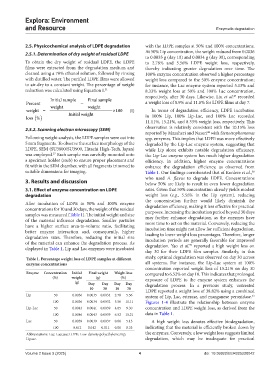
            Table 1. Percentage weight loss of LDPE samples at different   study, optimal degradation was observed on day 30 across
            enzyme concentrations                              all systems. For instance, the Lip-Lac system at 100%
                                                               concentration reported weight loss of 15.21% on day 30
            Enzyme  Concentration   Initial   Final weight   Weight loss   compared to 6.52% on day 10. This indicates that prolonged
                       (%)     weight     (g)       (%)        exposure of LDPE to the enzyme system enhances the
                                 (g)   Day   Day   Day   Day   degradation process. In a previous study, untreated
                                       10    30   10   30      LDPE reported a weight loss of 38.82% using a combined
            Lip         50      0.0036  0.0035 0.0034  2.78  5.56  system of Lip, Lac, esterase, and manganese peroxidase.
                                                                                                            53
                        100     0.0036  0.0034 0.0032  5.56  11.11  Figures  1-4 illustrate the relationship between enzyme
            Lip-Lac     50      0.0043  0.0041 0.0039  4.65  9.30  concentration and LDPE weight loss, as derived from the
                        100     0.0046  0.0043 0.0039  6.52  15.21  data in Table 1.
            Lac         50      0.0039  0.0039 0.0037  0.00  5.13  A high weight loss denotes effective biodegradation,
                        100     0.012  0.012  0.011  0.00  8.33  indicating that the material is efficiently broken down by
            Abbreviations: Lac: Laccase; LDPE: Low-density polyethylene; Lip:   the enzymes. Conversely, a low weight loss suggests limited
            Lipase.                                            degradation, which may be inadequate for practical


            Volume 2 Issue 3 (2025)                         4                           doi: 10.36922/EER025220042

