


Page 113 - EER-2-3
P. 113
Explora: Environment
            and Resource                                                                     Enzymatic degradation


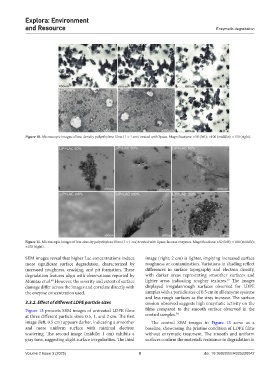
            Figure 10. Microscopic images of low-density polyethylene films (1 × 1 cm) treated with lipase. Magnifications: ×50 (left); ×100 (middle); ×150 (right).


            Figure 11. Microscopic images of low-density polyethylene films (1 × 1 cm) treated with lipase-laccase enzymes. Magnifications: ×50 (left); ×100 (middle);
            ×150 (right).

            SEM images reveal that higher Lac concentrations induce   image (right; 2 cm) is lighter, implying increased surface
            more significant surface degradation, characterized by   roughness or contamination. Variations in shading reflect
            increased roughness, cracking, and pit formation. These   differences in surface topography and electron density,
            degradation features align with observations reported by   with  darker  areas representing  smoother  surfaces  and
                                                                                                  73
            Mumtaz et al.  However, the severity and extent of surface   lighter areas indicating rougher textures.  The images
                       68
            damage differ across the images and correlate directly with   displayed irregular/rough surfaces observed for LDPE
            the enzyme concentration used.                     samples with a particle size of 0.5 cm in all enzyme systems
                                                               and less rough surfaces as the sizes increase. The surface
            3.3.2. Effect of different LDPE particle sizes     erosion observed suggests high enzymatic activity on the
            Figure 13 presents SEM images of untreated LDPE films   films compared to the smooth surface observed in the
            at three different particle sizes: 0.5, 1, and 2 cm. The first   control samples. 74
            image (left; 0.5 cm) appears darker, indicating a smoother   The  control  SEM  images  in  Figure  13  serve  as  a
            and more uniform surface with minimal electron     baseline, showcasing the pristine condition of LDPE films
            scattering. The second image (middle; 1  cm) exhibits a   without enzymatic treatment. The smooth and uniform
            gray tone, suggesting slight surface irregularities. The third   surfaces confirm the material’s resistance to degradation in


            Volume 2 Issue 3 (2025)                         8                           doi: 10.36922/EER025220042

