


Page 114 - EER-2-3
P. 114
Explora: Environment
            and Resource                                                                     Enzymatic degradation


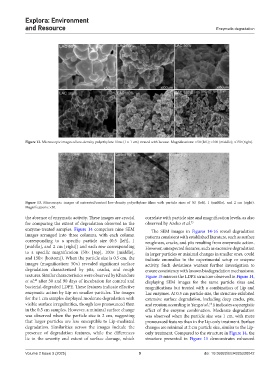
            Figure 12. Microscopic images of low-density polyethylene films (1 × 1 cm) treated with laccase. Magnifications: ×50 (left); ×100 (middle); ×150 (right).


            Figure  13.  Microscopic images of untreated/control low-density polyethylene films with particle  sizes  of 0.5 (left),  1 (middle),  and 2  cm  (right).
            Magnifications: ×50.

            the absence of enzymatic activity. These images are crucial   correlate with particle size and magnification levels, as also
            for comparing the extent of degradation observed in the   observed by Azeko et al. 75
            enzyme-treated samples.  Figure  14 comprises nine SEM   The SEM images in  Figures  14-16 reveal degradation
            images arranged into three columns, with each column   patterns consistent with established literature, such as surface
            corresponding to a specific particle size (0.5 [left], 1   roughness, cracks, and pits resulting from enzymatic action.
            [middle], and 2 cm [right]) and each row corresponding   However, unexpected features, such as excessive degradation
            to  a  specific  magnification  (50×  [top],  100×  [middle],   in larger particles or minimal changes in smaller ones, could
            and 150× [bottom]). When the particle size is 0.5 cm, the   indicate anomalies in the experimental setup or enzyme
            images (magnification: 50×) revealed significant surface   activity. Such deviations warrant further investigation to
            degradation characterized by pits, cracks, and rough   ensure consistency with known biodegradation mechanisms.
            textures. Similar characteristics were observed by Khandare   Figure 15 mirrors the LDPE structure observed in Figure 14,
                49
            et al.  after 30 and 90 days of incubation for control and   displaying SEM images for the same particle sizes and
            bacterial-degraded LDPE. These features indicate effective   magnifications but treated with a combination of Lip and
            enzymatic action by Lip on smaller particles. The images   Lac enzymes. At 0.5 cm particle size, the structure exhibited
            for the 1 cm samples displayed moderate degradation with   extensive surface degradation, including deep cracks, pits,
            visible surface irregularities, though less pronounced than   and erosion; according to Yang et al.,  it indicates a synergistic
                                                                                          56
            in the 0.5 cm samples. However, a minimal surface change   effect of  the enzyme combination.  Moderate  degradation
            was observed when the particle size is 2 cm, suggesting   was observed when the particle size was 1 cm, with more
            that larger particles are less susceptible to Lip-mediated   pronounced features than in the Lip-only treatment. Surface
            degradation. Similarities across the images include the   changes are minimal at 2 cm particle size, similar to the Lip-
            presence of degradation features, while the differences   only treatment. Compared to the structure in Figure 14, the
            lie in the severity and  extent of surface damage, which   structure presented  in  Figure  15 demonstrates  enhanced


            Volume 2 Issue 3 (2025)                         9                           doi: 10.36922/EER025220042

