


Page 110 - EER-2-3
P. 110
Explora: Environment
            and Resource                                                                     Enzymatic degradation


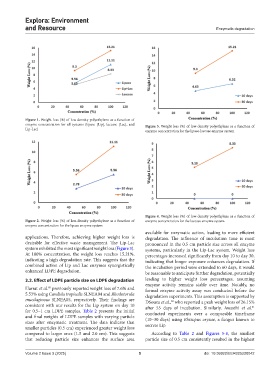
            Figure 1. Weight loss (%) of low-density polyethylene as a function of
            enzyme concentration for all systems (lipase [Lip], laccase [Lac], and   Figure 3. Weight loss (%) of low-density polyethylene as a function of
            Lip-Lac)                                           enzyme concentration for the lipase-laccase enzyme system


                                                               Figure 4. Weight loss (%) of low-density polyethylene as a function of
            Figure 2. Weight loss (%) of low-density polyethylene as a function of   enzyme concentration for the laccase enzyme system
            enzyme concentration for the lipase enzyme system
                                                               available for enzymatic action, leading to more efficient
            applications. Therefore, achieving higher weight loss is   degradation.  The  influence  of  incubation  time  is  most
            desirable  for  effective  waste  management.  The Lip-Lac   pronounced in the 0.5 cm particle size across all enzyme
            system exhibited the most significant weight loss (Figure 3).   systems, particularly in the Lip-Lac system. Weight loss
            At 100% concentration, the weight loss reaches 15.21%,   percentages increased significantly from day 10 to day 30,
            indicating a high degradation rate. This suggests that the   indicating that longer exposure enhances degradation. If
            combined action of Lip and Lac enzymes synergistically   the incubation period were extended to 60 days, it would
            enhanced LDPE degradation.                         be reasonable to anticipate further degradation, potentially

            3.2. Effect of LDPE particle size on LDPE degradation  leading  to higher weight loss percentages,  assuming
                                                               enzyme activity remains stable over time. Notably, no
            Harrat et al.  previously reported weight loss of 7.6% and   formal enzyme activity assay was conducted before the
                     60
            5.53% using Candida tropicalis SLNEA04 and Rhodotorula   degradation experiments. This assumption is supported by
            mucilaginosa SLNEA05, respectively. Their findings are   DSouza et al.,  who reported a peak weight loss of 26.15%
                                                                          50
            consistent with our results for the Lip system on day 10   after 55  days of incubation. Similarly, Awasthi  et  al.
                                                                                                            61
            for 0.5–1 cm LDPE samples. Table 2 presents the initial   conducted  experiments  over  a  comparable  timeframe
            and final weights of LDPE samples with varying particle   (10–30 days) using Rhizopus oryzae, a fungus known to
            sizes after enzymatic treatment. The data indicate that
            smaller particles (0.5 cm) experienced greater weight loss   secrete Lip.
            compared to larger ones (1.5 and 2.0 cm). This suggests   According to  Table 2 and  Figures  5-8, the smallest
            that  reducing  particle  size  enhances  the  surface  area   particle size of 0.5 cm consistently resulted in the highest


            Volume 2 Issue 3 (2025)                         5                           doi: 10.36922/EER025220042

