


Page 112 - EER-2-3
P. 112
Explora: Environment
            and Resource                                                                     Enzymatic degradation


            consistently  achieving  higher  weight  loss  percentages   confirms  the  material’s  resistance  to  degradation  in  the
            across all particle sizes. This synergistic effect enhances   absence of enzymatic activity. These control images are
            LDPE breakdown, making it the preferred enzymatic   crucial for comparing the extent of degradation observed
            treatment for effective biodegradation.            in the enzyme-treated LDPE samples. It was previously
                                                               established that the PE surface changes  after 30  days of
            3.3. Microscopy imaging of enzyme-treated LDPE     incubation with enzymes. 65
            samples
                                                                 Figure 9, representing the control LDPE film, exhibits
            3.3.1. Effect of different enzyme concentrations   a smooth and uniform surface, indicating no degradation.
            Rough surfaces and pore structures are observed in all   In contrast,  Figure  10, depicting the LDPE film treated
            LDPE samples incubated with enzymes, and the features   with Lip, displays noticeable surface alterations, such as
            are more significant in samples incubated in 100% enzyme   pits, grooves, and rough textures, similar to a previous
                                                                                             66
                                                                                                            67
            concentration, likely due to enzymatic activity on the   observation using  Bacillus  spp. YP1.  Das and Kumar
                        64
            LDPE samples.  Figures 9-12 display the SEM images of   inferred that Lip treatment initiates the LDPE degradation
            LDPE films (1 × 1 cm). Each image illustrates the surface   process, leading to polymer surface breakdown. Figure 10
            morphology of LDPE under different treatment conditions:   presents the SEM images of LDPE films treated with Lip at
            untreated/control (Figure 9), Lip-treated (Figure 10), Lip-  different magnifications. The images reveal the formation
            Lac-treated (Figure 11), and Lac-treated (Figure 12). The   of surface irregularities, including pits and cracks,
                                                                                                     68,69
            consistent sample size and imaging technique across these   indicating the onset of enzymatic degradation.   Higher
            figures facilitate a comparative analysis of the effects of   magnifications highlight more detailed degradation
                                                               features, such as micro-cracks and increased surface
            enzymatic treatments on LDPE surface degradation. The   roughness. The presence of white and dark areas in the
            SEM images in Figure 9 serve as a baseline, showcasing   images corresponds to differences in electron density,
            the pristine condition of the LDPE film without any   with white regions typically representing denser or
            enzymatic treatment. The smooth and defect-free surface   elevated areas and dark regions indicating depressions or
                                                               voids.  Figure 11 comprises six SEM images (at different
                                                                    70
                                                               magnifications) of LDPE films treated with a combination
                                                               of  Lip  and Lac  at  various  concentrations. The  images
                                                               demonstrate that higher enzyme concentrations lead to
                                                               more pronounced surface degradation, evident through
                                                                                                   71
                                                               extensive cracking, pitting, and roughness.  At higher
                                                               magnifications,  the  images  reveal  finer  degradation
                                                               details, such as micro-fissures and increased porosity.
                                                               The similarities across the images include the presence
                                                               of degradation features, while  differences arise from the
                                                               varying degrees of surface damage corresponding to
                                                               enzyme concentration.
                                                                 Figure  12 displays six SEM images of LDPE films
                                                               treated with Lac at different concentrations. Sowmya
                                                               et al.  assessed the degradation potential of crude Lac on
                                                                   72
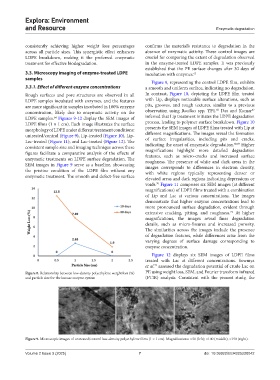
            Figure 8. Relationship between low-density polyethylene weight loss (%)   PE using weight loss, SEM, and Fourier transform infrared
            and particle size for the laccase enzyme system    (FTIR)  analysis.  Consistent  with  the  present  study,  the


            Figure 9. Microscopic images of untreated/control low-density polyethylene films (1 × 1 cm). Magnifications: ×50 (left); ×100 (middle); ×150 (right).


            Volume 2 Issue 3 (2025)                         7                           doi: 10.36922/EER025220042

